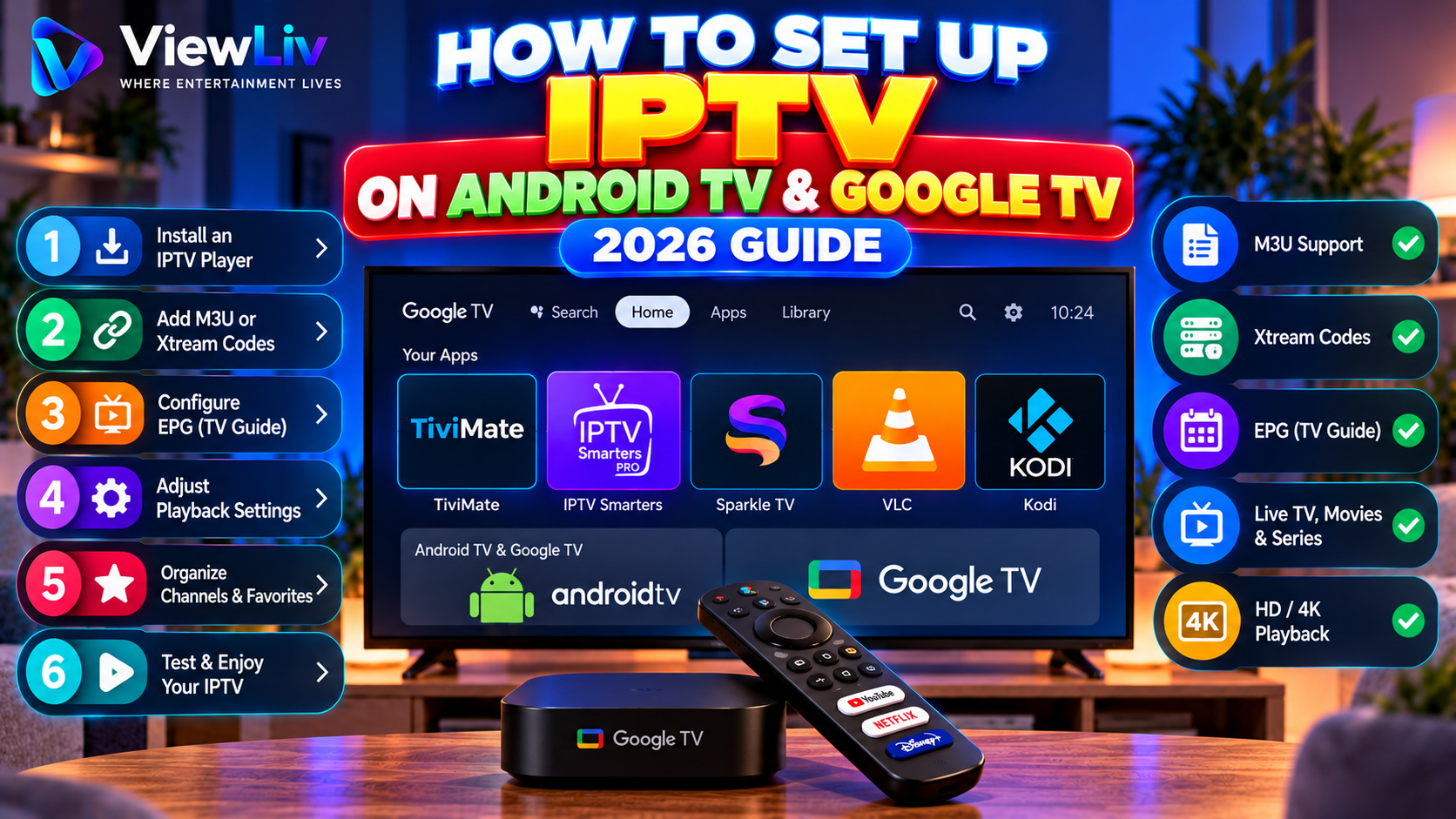
Android TV and Google TV are popular platforms for streaming entertainment on modern televisions and external streaming devices.
Both platforms support compatible media applications that can play authorized internet television streams, M3U playlists, and other network-based media.
However, first-time setup can be confusing if you are unfamiliar with IPTV players, playlist formats, or Electronic Program Guides.
In this 2026 complete guide, you'll learn how to set up IPTV on Android TV and Google TV, install a compatible media player, configure an M3U playlist or Xtream Codes-style account, organize channels, and troubleshoot common problems.
The instructions apply to compatible Android TV and Google TV televisions and streaming devices, although individual menus and features may vary.
What Is IPTV on Android TV and Google TV?
IPTV stands for Internet Protocol Television.
It refers to television and video delivery using internet-based networks.
Unlike traditional antenna or satellite-only television delivery, IPTV relies on network connections to retrieve media.
Android TV and Google TV provide operating environments for streaming applications, including compatible IPTV media players.
Depending on the player and authorized source, available features may include:
- Live television.
- Movies and series.
- M3U playlists.
- Xtream Codes-style login.
- Electronic Program Guides.
- Favorites and channel categories.
- Subtitles and audio-track selection.
- Video playback controls.
- Recording and timeshift on supported configurations.
Important: IPTV player applications do not necessarily include television channels or subscriptions. Users must supply their own properly authorized media sources.
For an introduction, read our What Is IPTV? How It Works, Benefits & Legal Considerations.
Android TV vs Google TV: What's the Difference?
Android TV and Google TV are closely related but have different interface experiences.
Android TV
Android TV is Google's television operating-system platform designed for large screens and remote-control navigation.
It supports compatible television applications, media playback, and streaming services.
Google TV
Google TV provides a content-focused interface built on Android TV OS on supported devices.
It emphasizes recommendations, content discovery, and integration with compatible services.
Do IPTV Apps Work on Both?
Many television-oriented Android applications work on both Android TV and Google TV.
However, compatibility is not guaranteed.
Application availability may depend on:
- Device model.
- Operating-system version.
- Country or region.
- Developer support.
- Hardware capabilities.
- Google Play availability.
Always check the application listing for your specific device.
What You Need Before Setting Up IPTV
Prepare the following before starting:
- A compatible Android TV or Google TV device.
- A stable internet connection.
- A Google account for normal Google Play access.
- A compatible IPTV media player.
- An authorized media playlist or streaming account.
- M3U playlist details or Xtream Codes-style credentials.
- A television remote or supported input device.
If your source requires an account, keep the server URL, username, and password available.
Avoid sharing private playlist links or credentials with anyone you do not trust.
Step 1: Connect Your Android TV or Google TV to the Internet
First, ensure your television or streaming device has internet access.
Connect Using Wi-Fi
- Turn on your Android TV or Google TV device.
- Open Settings.
- Navigate to the network or internet section.
- Select your Wi-Fi network.
- Enter the Wi-Fi password.
- Wait for the connection to complete.
Menu names may vary depending on the manufacturer and software version.
Connect Using Ethernet
Some televisions have a built-in Ethernet port.
External streaming devices may require a compatible Ethernet adapter.
A wired connection can reduce some wireless interference and provide more consistent connectivity.
Test the Connection
Open a trusted streaming application or another internet-enabled service.
If other applications also fail to connect, investigate the network before configuring IPTV.
Step 2: Choose a Compatible IPTV Player
An IPTV player is the application used to open and organize your authorized media streams.
Several applications are worth considering.
TiviMate
TiviMate is designed for television screens and remote-control navigation.
It supports M3U playlists, Xtream Codes-style connections, EPG, and channel organization.
Some advanced features require a paid upgrade.
Sparkle TV
Sparkle TV offers a television-oriented interface with playlist support, EPG, and additional playback features.
Some advanced capabilities, including certain recording features, require a paid upgrade and compatible hardware.
VLC Media Player
VLC is a free, open-source media player.
It supports M3U playlists and many network media formats.
However, VLC is not designed around the same dedicated IPTV account-management interface as specialized players.
Kodi
Kodi is an open-source media center.
With IPTV Simple Client, it can organize compatible M3U playlists and EPG information.
It may require more setup than a dedicated television player.
Which Player Should You Choose?
If you prioritize live television navigation, compare TiviMate and Sparkle TV.
For straightforward network media playback, consider VLC.
For a customizable media-center experience, Kodi may be suitable.
Read our Best IPTV Players for Smart TV, Android TV, Fire TV & Windows for a detailed comparison.
Step 3: Install an IPTV Player from Google Play
Installing applications from Google Play is generally the simplest approach on compatible Android TV and Google TV devices.
Installation Instructions
- Open the television's application section or Google Play interface.
- Select the search function.
- Enter the name of your chosen IPTV player.
- Review the results.
- Select the correct application.
- Verify the developer and compatibility.
- Choose Install.
- Wait for installation to complete.
- Open the application.
On some Google TV devices, app search is integrated into the main interface rather than a separate Play Store screen.
Security tip: Avoid downloading modified IPTV application packages from unknown websites. Prefer trusted distribution sources and verified developers.
Step 4: Set Up IPTV Using an M3U Playlist
An M3U playlist is a text-based file or URL containing references to media resources.
Many IPTV players support M3U playlists.
M3U Setup Instructions
- Open your installed IPTV player.
- Find Add Playlist, Add Source, or a similar option.
- Select the M3U playlist method.
- Enter your authorized M3U playlist URL.
- Enter a playlist name if requested.
- Save the configuration.
- Wait for the player to load the playlist.
- Select an available authorized stream to test playback.
Some players also support locally stored M3U files.
Example M3U Format
A simplified playlist may look like this:
#EXTM3U
#EXTINF:-1,Example Channel
https://example.com/authorized-stream.m3u8
This is an illustration of playlist structure, not an active media source.
If the playlist fails to load, verify that the URL is correct and accessible.
For more details, see What Is an M3U Playlist? How It Works & How to Use It.
Step 5: Set Up IPTV Using Xtream Codes
Some dedicated IPTV players support Xtream Codes-style connections.
This method typically uses three main fields:
- Server URL.
- Username.
- Password.
Xtream Codes Setup Instructions
- Open your IPTV player.
- Select Add Playlist or Add Account.
- Choose the Xtream Codes-style login method.
- Enter the server URL supplied by your authorized provider.
- Enter your username.
- Enter your password.
- Add a profile name if requested.
- Save the account.
- Allow the player to retrieve the available media information.
Common Login Mistakes
Avoid:
- Entering the wrong server URL.
- Adding unnecessary spaces.
- Confusing the username with the profile name.
- Using an expired account.
- Selecting the wrong connection method.
- Copying incomplete credentials.
If the login fails despite correct details, contact the authorized service provider.
For a comparison of connection formats, read M3U vs Xtream Codes: What's the Difference?.
Step 6: Configure the Electronic Program Guide
An Electronic Program Guide, or EPG, displays television schedules and programme information.
Some media providers include EPG data with their playlists or account connections.
Other configurations may require a separate authorized guide source.
EPG Setup Instructions
- Open the IPTV player's settings.
- Find the EPG or TV Guide section.
- Check whether guide information is already configured.
- If manual configuration is supported, enter the correct EPG source.
- Save the settings.
- Refresh the guide information.
- Check the displayed schedules.
What If the EPG Is Empty?
Possible causes include:
- No guide data supplied.
- Incorrect EPG URL.
- Unmatched channel identifiers.
- Temporary source problems.
- Guide refresh errors.
What If the EPG Time Is Wrong?
Check the device's date, time, and time-zone settings.
Some applications also provide EPG time-offset options.
Only change the offset when necessary.
Step 7: Organize Channels and Favorites
After loading your authorized playlist, you may want to customize the interface.
Depending on your media player, you may be able to:
- Mark favorite channels.
- Hide unused categories.
- Search by channel name.
- Reorder channel groups.
- Manage multiple playlists.
- Configure parental controls.
- Customize programme-guide layouts.
For a television used by several family members, favorites and category organization can make navigation easier.
Not every application supports all these options.
Step 8: Optimize Video and Audio Playback
Different Android TV and Google TV devices have different processing capabilities.
Correct playback settings can improve compatibility and usability.
Video Resolution
Choose a resolution appropriate for your television, media source, and available network bandwidth.
A 4K television does not guarantee that every stream is delivered in 4K.
Hardware Decoding
Some IPTV players offer hardware and software decoding options.
Hardware decoding may reduce processing demands for supported codecs.
If a particular stream shows a black screen or playback artifacts, check the player's available decoding options.
Aspect Ratio
Use an aspect-ratio setting that preserves the original video proportions when possible.
Stretching the image can make people and objects appear distorted.
Audio Tracks
Select the correct audio language or output format if the stream supports multiple tracks.
Subtitles
Enable subtitles where available.
Subtitle support depends on both the player and the media source.
Step 9: Test Your IPTV Setup
Once configuration is complete, test the player before changing additional settings.
Recommended Playback Test
- Open a permitted live television stream.
- Confirm that video appears.
- Check that audio works.
- Navigate using the remote.
- Open the EPG if available.
- Switch to another authorized stream.
- Test subtitles or alternate audio tracks if needed.
- Observe playback stability.
If everything works, your basic IPTV setup is complete.
If a problem appears, identify whether it affects one stream, one application, or the entire device.
How to Set Up IPTV on Chromecast with Google TV
Chromecast with Google TV devices support compatible television applications.
The general process is:
- Connect the Chromecast device to your television.
- Complete the initial Google TV setup.
- Connect to the internet.
- Search for a compatible IPTV media player.
- Install the application.
- Open the player.
- Add your authorized M3U or supported account connection.
- Configure the EPG if necessary.
- Test playback.
The exact interface depends on the device generation and software version.
Check compatibility before installing.
How to Set Up IPTV on Sony, TCL, Hisense and Other Android TVs
Some televisions from Sony, TCL, Hisense, Philips, and other manufacturers use Android TV or Google TV.
For compatible models, the setup process is generally similar:
- Connect the television to the internet.
- Open the application search interface.
- Find a compatible media player.
- Install it from a trusted source.
- Add your authorized playlist or account details.
- Configure guide and playback settings.
- Test the streams.
However, not every television from these manufacturers runs Android TV or Google TV.
Some models use entirely different operating systems.
Always confirm the actual software platform of your television.
IPTV Buffering on Android TV: How to Fix It
Buffering occurs when the player cannot receive or process video data quickly enough to maintain continuous playback.
Common Causes
- Weak Wi-Fi.
- Network congestion.
- High streaming bitrate.
- Source-server instability.
- Device processing limitations.
- Application playback problems.
Troubleshooting Steps
- Test the internet connection.
- Restart the router and television.
- Compare Wi-Fi with Ethernet if available.
- Reduce unnecessary network activity.
- Update the IPTV player.
- Test a lower stream quality if available.
- Compare playback using another authorized stream.
No media player can guarantee zero buffering under all network and source conditions.
For a complete troubleshooting guide, read How to Fix IPTV Buffering and Freezing: 15 Proven Tips.
IPTV Not Working on Android TV or Google TV?
If your application opens but content does not play, the cause may involve the media source, account configuration, or player compatibility.
Problem 1: IPTV Player Won't Open
Restart the device and check for application updates.
If supported, clear the application's cache.
Problem 2: Invalid Login
Verify the server URL, username, password, and account status.
Problem 3: M3U Playlist Not Loading
Check the playlist address and internet connection.
Problem 4: Black Screen
Test another authorized stream and review supported video formats.
Problem 5: No Sound
Check the television's volume, audio output, and available audio tracks.
Problem 6: EPG Not Working
Verify the guide source, channel mapping, and time-zone settings.
Problem 7: Channels Missing
Refresh the playlist and check for hidden categories.
Problem 8: App Crashing
Update the application, restart the device, and check available storage.
Problem 9: Movies or Series Not Loading
Test another authorized title and check the player's media-format compatibility.
Problem 10: Connection Timed Out
Check network connectivity and whether the authorized source is responding.
For additional solutions, see IPTV Not Working? 15 Common Problems and How to Fix Them.
How to Clear IPTV App Cache on Android TV
Clearing temporary application files may resolve some performance or startup problems.
On many Android TV and Google TV devices:
- Open Settings.
- Navigate to Apps.
- Select your IPTV player.
- Open its storage or application-information section.
- Choose Clear Cache, if available.
- Restart the application.
Menu labels vary by device.
Warning: Clear Cache and Clear Data are different operations.
Clearing application data may remove saved playlists, accounts, preferences, and profiles.
Back up necessary information before resetting the application.
How to Update IPTV Players on Google TV
Keeping applications updated can help with compatibility and security.
On compatible devices:
- Open Google Play or the device's app-management interface.
- Find the installed application.
- Check whether an update is available.
- Install the official update.
- Restart the application if necessary.
Some devices support automatic application updates.
Use official distribution sources whenever possible.
Android TV vs Fire TV Stick for IPTV
Both Android TV/Google TV and Amazon Fire TV devices can support compatible media players.
However, application availability and operating-system compatibility differ.
| Feature | Android TV / Google TV | Amazon Fire TV | |---|---|---| | Primary app ecosystem | Google Play on supported devices | Amazon Appstore on supported devices | | M3U playback | Through compatible players | Through compatible players | | Xtream Codes-style login | Through supported players | Through supported players | | EPG support | Player-dependent | Player-dependent | | External streaming hardware required | Only for external devices | For Fire TV Stick | | App compatibility | Depends on device and OS | Depends on device and OS |
Neither platform guarantees better IPTV performance.
Network conditions, hardware, media formats, and application quality all influence playback.
For Fire TV-specific instructions, read How to Install IPTV on Amazon Fire TV Stick.
Is IPTV Legal on Android TV and Google TV?
IPTV is a technology for delivering television and video over internet-based networks.
It can be used for legitimate activities such as:
- Watching licensed streaming services.
- Accessing authorized television broadcasts.
- Playing personal network media.
- Viewing publicly distributed streams with appropriate permissions.
However, a media player does not automatically grant access rights to copyrighted content.
Users should obtain media from properly authorized sources and follow applicable laws and service terms.
Frequently Asked Questions About IPTV on Android TV and Google TV
Can I install IPTV on Android TV?
Yes. Compatible Android TV devices support media players capable of playing authorized IPTV streams.
Does Google TV support IPTV?
Yes. Google TV devices can run compatible media applications, subject to device and operating-system support.
What is the best IPTV player for Android TV?
TiviMate and Sparkle TV are two television-focused options. VLC and Kodi are also useful for different requirements.
Is IPTV free on Google TV?
Some IPTV players are free, while others offer paid features. Access to specific media may require a separate authorized subscription.
Can I use an M3U playlist on Google TV?
Yes, if the installed player supports M3U playlists and the source is accessible.
Can I use Xtream Codes on Android TV?
Some IPTV players support Xtream Codes-style account connections using a server URL, username, and password.
Do I need a VPN for IPTV on Android TV?
A VPN is not inherently required for IPTV playback. It does not fix incorrect credentials, unsupported codecs, or unavailable media sources.
Why is IPTV buffering on Google TV?
Possible causes include unstable Wi-Fi, network congestion, high video bitrate, device limitations, or source problems.
Why is my IPTV showing a black screen?
The stream may be unavailable or use a video format that the player or device cannot decode correctly.
How do I update an IPTV player?
Check the official application store or the application's trusted update mechanism.
Can I install IPTV on Sony Google TV?
Many Sony televisions running Google TV support compatible media applications. Check the exact model and app availability.
Can I install IPTV on TCL Android TV?
Compatible TCL televisions running Android TV can use supported media players. Other TCL models may use different operating systems.
Can I watch 4K IPTV on Google TV?
Some Google TV devices support 4K playback, but the source, codec, bandwidth, and television must also be compatible.
Can I record IPTV on Android TV?
Some players offer recording functionality. It depends on the application, storage, hardware, media source, and content permissions.
Does an IPTV player include television channels?
Usually not. Most IPTV players are software applications that require users to provide their own authorized media sources.
Final Thoughts
Setting up IPTV on Android TV or Google TV in 2026 is generally straightforward when you choose a compatible media player and have the correct authorized connection information.
Start by connecting your device to the internet and installing a trusted media player.
Next, add your M3U playlist or Xtream Codes-style account, configure the EPG, and organize the available channels.
Finally, test playback and adjust settings only when necessary.
For more practical guides, visit the ViewLiv Blog, including our tutorials on Smart TV IPTV Setup, Best IPTV Players, and IPTV Troubleshooting.
Published by ViewLiv — Where Entertainment Lives.
Disclaimer: This article is provided for educational purposes. ViewLiv recommends using trusted applications and properly authorized streaming sources. Application features, availability, and compatibility vary by device and region.