Starting an IPTV reseller business can be an opportunity for entrepreneurs interested in digital television, subscription services, and recurring-revenue businesses.
However, becoming a successful IPTV reseller requires more than purchasing a reseller panel and selling subscriptions.
You need to understand content licensing, supplier agreements, startup costs, customer support, pricing, subscription renewals, payment collection, and financial management.
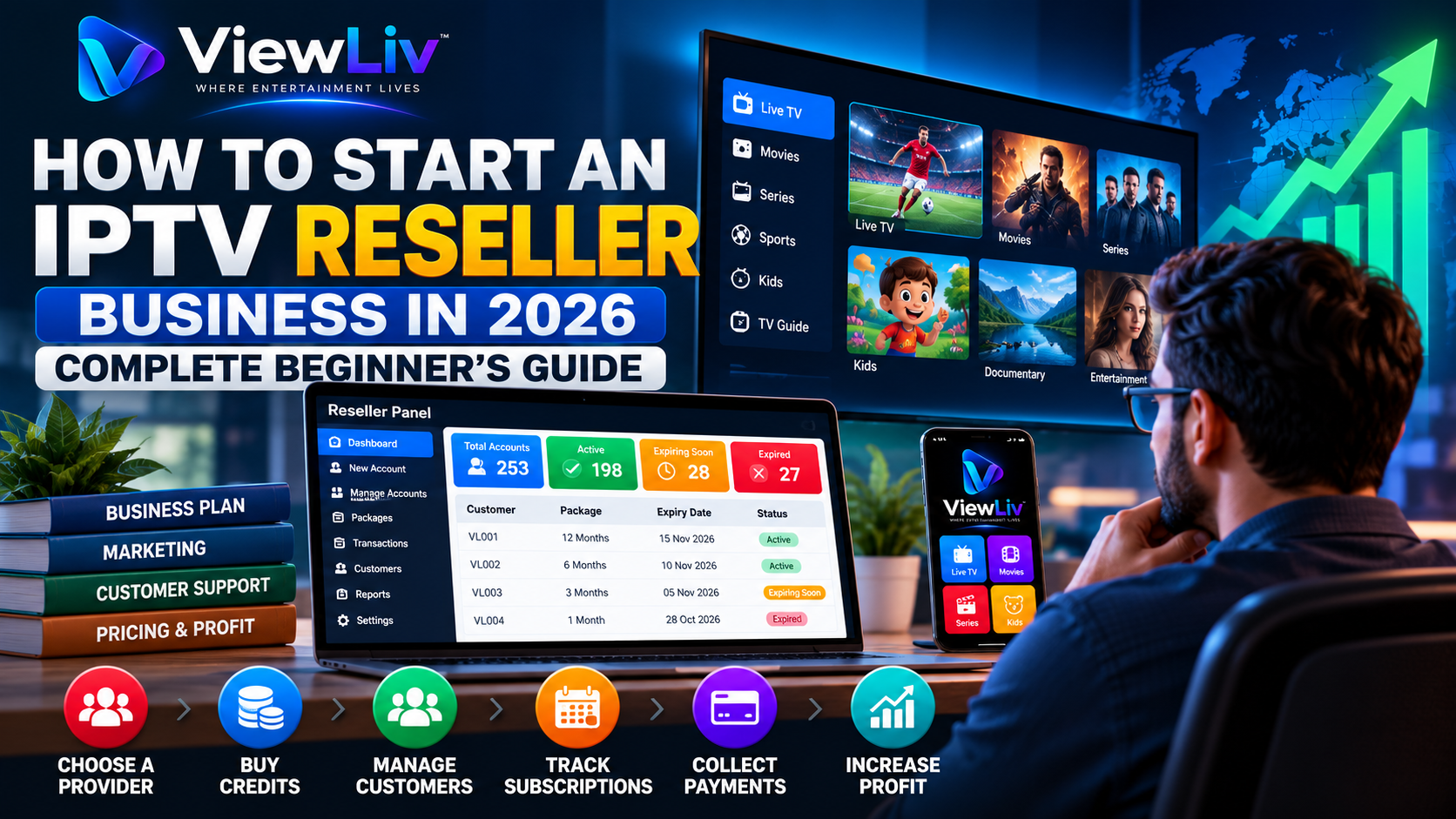
In this 2026 beginner's guide, we'll explain how an IPTV reseller business works, what a reseller panel does, how much money you may need to start, and how to organize your operations professionally.
We'll also cover common mistakes and practical ways to manage customers, subscriptions, expenses, and profits.
What Is an IPTV Reseller Business?
An IPTV reseller business sells access to authorized internet-based television or streaming services on behalf of a service provider or platform operator.
IPTV stands for Internet Protocol Television, meaning television or video content delivered over IP-based networks.
A reseller typically does not operate the entire streaming infrastructure.
Instead, the reseller works with a provider that supplies the underlying service and an approved method for managing customer accounts.
Depending on the arrangement, the reseller may be responsible for:
- Finding customers.
- Explaining available subscription plans.
- Activating authorized customer accounts.
- Managing renewals.
- Collecting payments.
- Providing first-level customer support.
- Tracking subscription expenses.
- Monitoring sales and profitability.
The exact responsibilities depend on the reseller agreement.
Important: A reseller panel or subscription account does not establish that a provider has the rights to distribute its content. Before selling any television or video service, verify that the provider holds the necessary rights and authorizes your resale activities in the markets you intend to serve.
For a basic introduction, read What Is IPTV? How It Works, Benefits & Legal Considerations.
How Does an IPTV Reseller Business Work?
A typical authorized reseller arrangement involves three parties.
1. IPTV Service Provider
The provider operates or supplies the streaming service and is responsible for the underlying service infrastructure, subject to its contractual obligations.
The provider may offer:
- Subscription packages.
- Account management.
- Approved reseller access.
- Technical documentation.
- Customer activation tools.
- Service status information.
- Technical support.
2. IPTV Reseller
The reseller markets and sells the provider's authorized service to customers.
The reseller may use a dashboard to create accounts, manage subscription durations, and monitor customer activity.
3. Customer
The customer purchases an authorized subscription and accesses the service through supported applications or devices.
The customer may require assistance with installation, account activation, or renewal.
Example Business Workflow
A simple transaction might follow this process:
- A customer requests a subscription.
- The reseller explains the available packages.
- The customer selects a plan.
- The reseller confirms payment.
- The reseller activates an account through an approved system.
- The customer receives connection instructions.
- The reseller records the sale and supplier cost.
- The reseller tracks the subscription expiry date.
- The customer is contacted about renewal when appropriate.
This workflow becomes more important as the customer base grows.
Step 1: Understand the Legal Requirements
Before spending money on a reseller panel, investigate the legal and contractual requirements of the business.
This is one of the most important steps.
Content Distribution Rights
Television channels, movies, sports broadcasts, and other copyrighted programmes often require specific distribution permissions.
A service provider may need rights covering:
- The content being distributed.
- The countries where it is offered.
- The method of delivery.
- Commercial resale.
- Particular devices or platforms.
- Subscription and customer access.
A provider's ability to stream content does not automatically establish the right to appoint resellers.
Verify Reseller Authorization
Ask the provider for documentation confirming that it is permitted to distribute the relevant content and authorize resellers.
Review the agreement carefully.
Business Registration
Depending on your jurisdiction, you may need to register a business, maintain financial records, and comply with applicable tax obligations.
Customer Privacy
Customer names, contact information, and account details should be handled securely and in accordance with applicable privacy requirements.
Advertising Claims
Avoid promising features or content that the authorized service cannot substantiate.
For example, do not advertise a particular sports competition, television channel, or movie library unless the provider is authorized to offer it and the claim is accurate.
A reseller panel is a management tool, not proof of content licensing.
Step 2: Research Your Target Market
A reseller business needs a clearly defined customer audience.
Before choosing a service, identify the market you want to serve.
Questions to Research
- Which countries will you target?
- What types of authorized television services are customers seeking?
- Which devices do customers use?
- What subscription prices are competitive?
- Which payment methods are convenient?
- What support hours will customers expect?
- What languages should your support team use?
Potential Customer Groups
Depending on your licensing arrangements, customers may include:
- Households seeking authorized television services.
- Customers looking for compatible streaming-device support.
- Users who prefer flexible subscription periods.
- Businesses with appropriate commercial viewing rights.
- Customers interested in specialized, legally distributed programming.
Do not assume that a residential subscription permits public or commercial exhibition.
Why Market Research Matters
A reseller who understands the target audience can choose suitable plans, provide better support, and avoid unnecessary spending.
Step 3: Choose an Authorized IPTV Provider
Your provider is one of the most important business relationships.
A low wholesale price is not enough.
What to Evaluate
Licensing and authorization: Confirm that the provider has the necessary distribution rights and permits resale.
Service reliability: Test authorized streams under normal conditions.
Device compatibility: Verify which applications and devices are officially supported.
Customer support: Understand how technical problems and outages are handled.
Reseller tools: Check whether the provider offers account management, renewal tracking, and transaction history.
Wholesale pricing: Review subscription costs and any minimum purchase requirements.
Refund policies: Understand when credits or subscription fees may be refunded.
Contract terms: Review termination conditions, payment obligations, and customer ownership provisions.
Warning Signs
Be cautious when a provider:
- Refuses to explain its distribution rights.
- Makes unrealistic claims about unlimited premium content.
- Cannot provide clear reseller terms.
- Requires large payments without documentation.
- Offers no reliable support channel.
- Frequently changes access arrangements without explanation.
A professional reseller business should be built on verifiable rights, clear agreements, and dependable service.
Step 4: Understand IPTV Reseller Panels
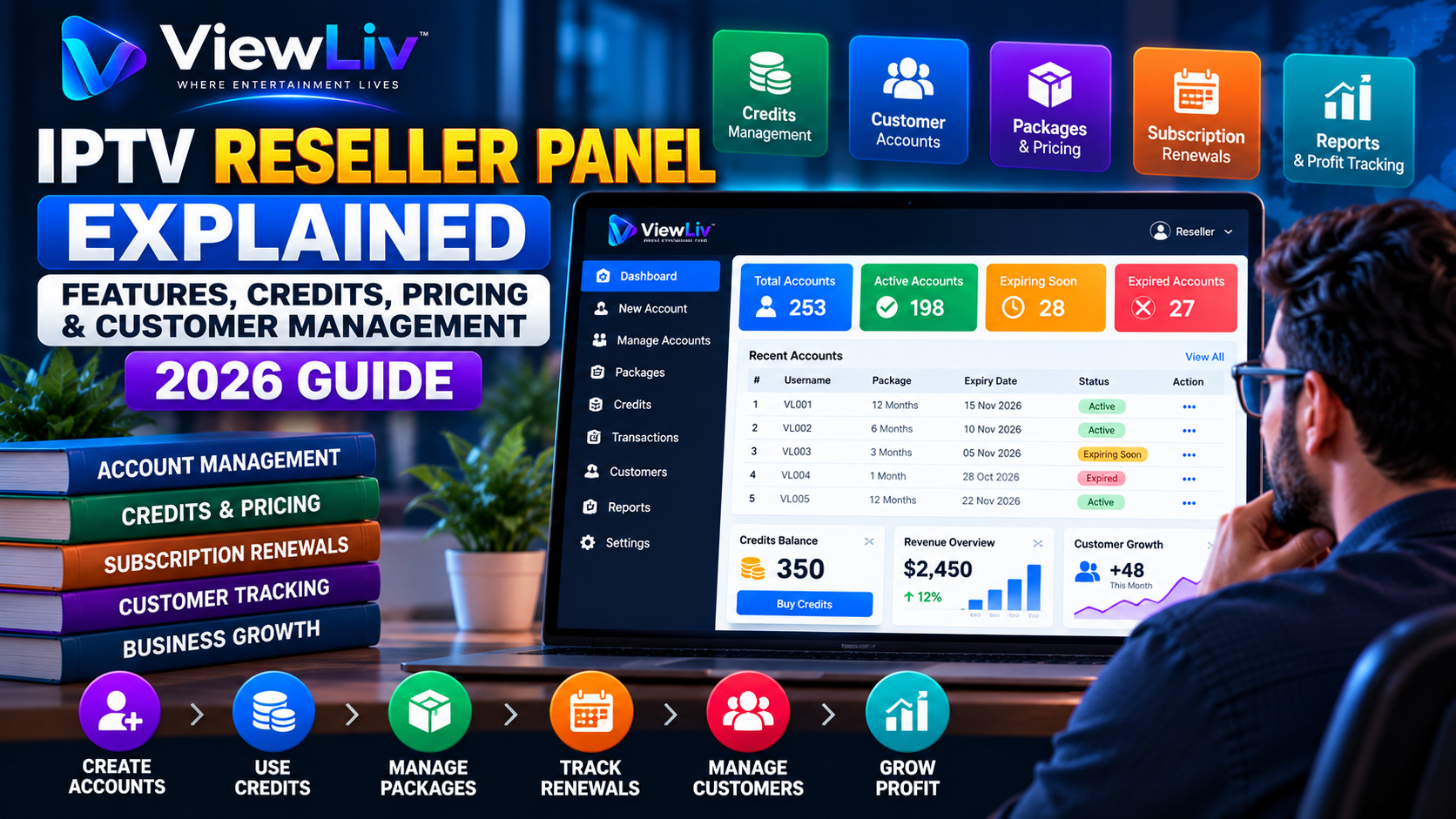
An IPTV reseller panel is a management dashboard used by some providers to administer customer accounts.
Depending on the provider, a panel may allow resellers to:
- Create customer accounts.
- Activate subscriptions.
- Renew existing accounts.
- View account expiry dates.
- Assign service packages.
- Manage supported devices.
- Review credit balances.
- Monitor account status.
- Access transaction records.
The exact features depend on the platform.
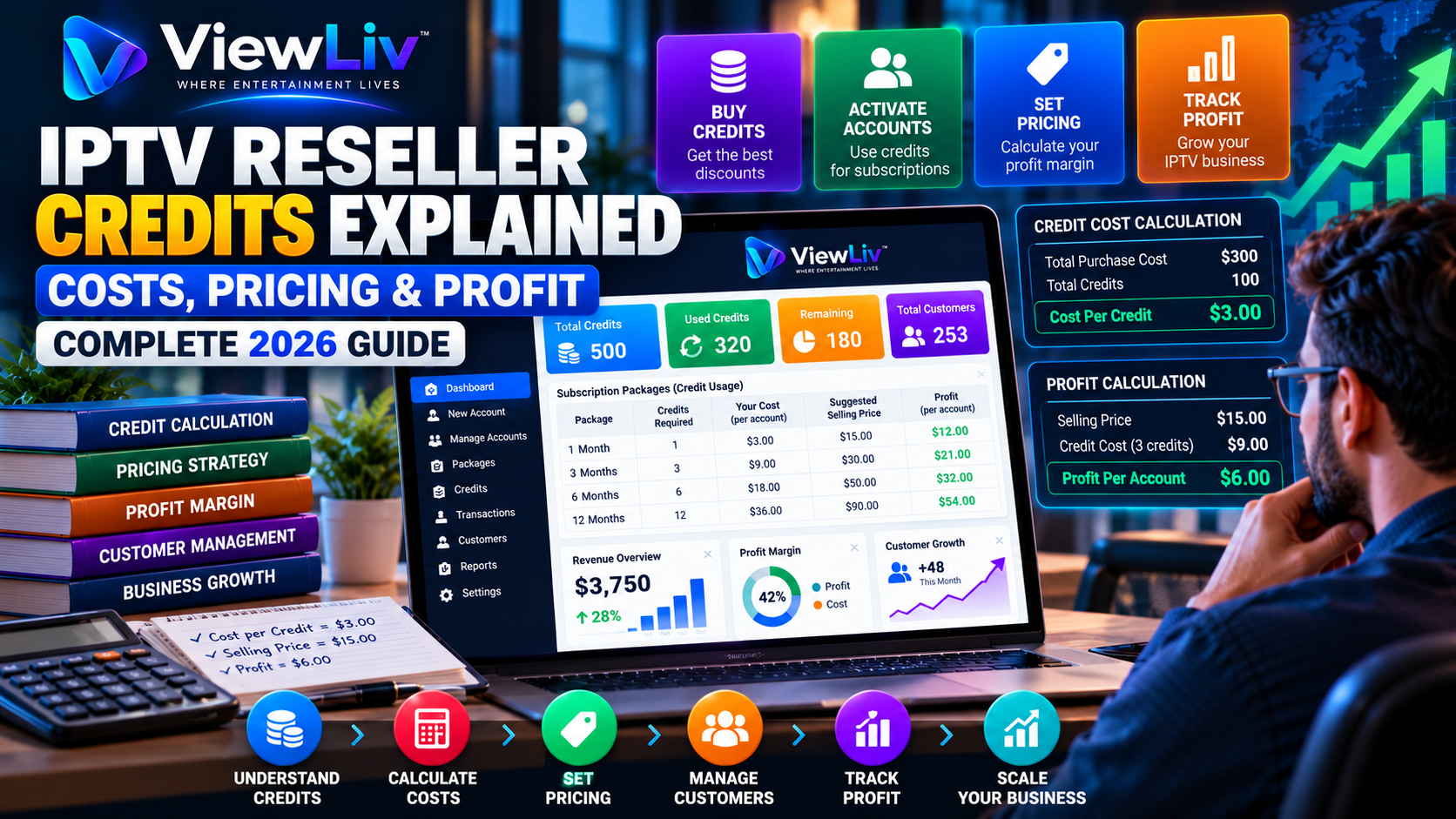
What Is a Reseller Credit?
Some providers use a credit-based wholesale model.
In this system, resellers purchase a balance of credits and spend them when activating eligible customer subscriptions.
However, credits are not standardized across the IPTV industry.
For example, one provider might charge one credit for a particular package, while another might use a different calculation.
Always confirm the actual credit-to-subscription conversion and any expiry rules.
Does Every Provider Use Credits?
No.
Some providers use direct wholesale subscription pricing, prepaid account packages, or other billing arrangements.
The reseller's accounting system should support the provider's actual business model.
Step 5: Calculate Your Startup Costs
Startup costs depend on the provider, business structure, software, marketing, and customer support requirements.
There is no universal minimum investment.
A small reseller business may start with modest operating expenses, while a larger operation may require significantly more capital.
Example Startup Budget
The following amounts are illustrative planning assumptions in US dollars, not verified market prices.
| Expense | Example budget | |---|---:| | Initial authorized subscription inventory | $200 | | Website and domain allowance | $50 | | Business software allowance | $30 | | Initial marketing | $100 | | Support and miscellaneous expenses | $50 | | Emergency reserve | $100 | | Total | $530 |
Your actual costs may be higher or lower.
Additional expenses may include business registration, taxes, payment processing, legal review, and customer support equipment.
Start With a Controlled Budget
Avoid purchasing large quantities of nonrefundable credits before validating customer demand and provider reliability.
Keep a reserve for unexpected expenses.
Step 6: Create Your Subscription Packages
Subscription packages determine how customers purchase access.
Common billing periods include:
- 1 month.
- 3 months.
- 6 months.
- 12 months.
However, only offer durations supported by your authorized provider.
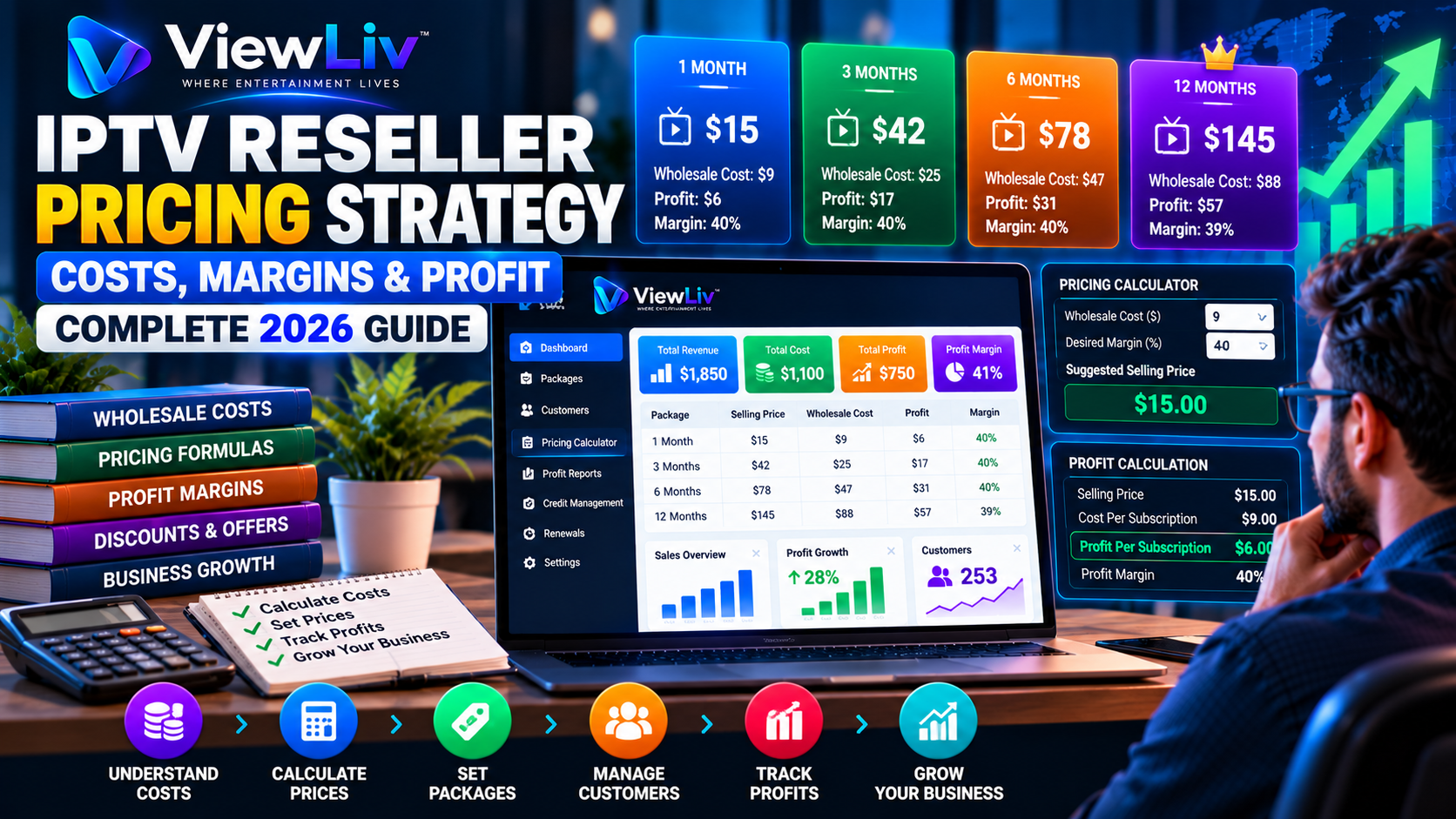
Example Package Structure
| Package | Duration | Example retail price | |---|---|---:| | Monthly | 1 month | $15 | | Quarterly | 3 months | $40 | | Half-yearly | 6 months | $75 | | Annual | 12 months | $140 |
These prices are hypothetical examples for financial planning, not ViewLiv service prices or recommendations for a specific market.
How to Choose Package Prices
Consider:
- Wholesale subscription cost.
- Payment processing fees.
- Customer support expenses.
- Marketing costs.
- Taxes.
- Refund and dispute risk.
- Desired profit margin.
- Competitor pricing for comparable authorized services.
Do not price a subscription solely by adding a small amount to the supplier's wholesale cost.
Step 7: Calculate IPTV Reseller Profit
Profitability is one of the most important parts of reseller management.
Basic Gross Profit Formula
Gross Profit = Subscription Revenue − Direct Subscription Cost
Suppose:
- Customer selling price: $15.
- Supplier cost: $9.
- Gross profit: $6.
The gross margin is:
($6 ÷ $15) × 100 = 40%
This is gross margin, not final net profit.
Net Profit Formula
Net Profit = Revenue − Direct Costs − Operating Expenses
Operating expenses may include:
- Advertising.
- Software.
- Payment processing.
- Support.
- Refunds and chargebacks.
- Other business overhead.
Example Monthly Profit Calculation
Assume you sell 50 monthly subscriptions.
| Item | Amount | |---|---:| | Revenue: 50 × $15 | $750 | | Supplier cost: 50 × $9 | $450 | | Gross profit | $300 | | Marketing | $60 | | Software | $15 | | Payment fees and support | $45 | | Net profit before tax | $180 |
This example assumes all 50 subscriptions are paid and delivered, and does not include every possible expense.
Actual profitability depends on your provider, customers, costs, and business model.
Step 8: Set Up Customer Management
As your business grows, customer information can become difficult to manage.
Even a small operation should maintain structured records.
Recommended Customer Information
- Unique customer code.
- Customer name, where needed.
- Contact details.
- Subscription package.
- Activation date.
- Expiry date.
- Supplier or vendor.
- Selling price.
- Supplier cost.
- Amount received.
- Outstanding balance.
- Renewal status.
Avoid collecting personal information you do not need.
Do not store passwords or sensitive credentials in unsecured spreadsheets or messages.
Why Customer Codes Matter
Unique customer codes reduce confusion when two customers have similar names.
They also help connect sales, payments, and renewal records.
Step 9: Manage Subscription Expiry Dates
Subscription management is essential for recurring-revenue businesses.
If you do not track expiry dates, customers may lose access without receiving timely renewal information.
Recommended Renewal Workflow
- Record the subscription activation date.
- Record the correct expiry date.
- Review upcoming expirations.
- Send a renewal reminder when appropriate.
- Confirm the customer's renewal request.
- Collect payment.
- Renew the authorized account.
- Update the expiry date.
- Record the transaction.
Avoid Renewal Errors
Check whether the provider extends an existing subscription or starts a new period immediately.
Renewal rules vary.
Do not promise customers that unused days will carry forward unless the provider supports that arrangement.
Step 10: Keep Accurate Sales and Expense Records
A reseller panel may show account activations without providing complete business accounting.
For example, it might show that a subscription was created but not whether the customer has paid in full.
You should separately track:
- Sales revenue.
- Supplier purchases.
- Credits used.
- Customer payments.
- Customer receivables.
- Supplier payables.
- Refunds.
- Operating expenses.
- Gross profit.
- Net profit.
Why Separate Accounting Matters
Suppose you activate a subscription costing $9 and sell it for $15.
If the customer pays only $10 initially, your records should show:
- Sale: $15.
- Supplier cost: $9.
- Payment received: $10.
- Customer balance: $5.
Without proper records, you might incorrectly treat the entire sale as cash received.
Step 11: Use Business Management Software
Spreadsheets can be useful when a business is very small.
However, manual records become harder to maintain as customer numbers, suppliers, transactions, and renewal dates increase.
Dedicated business software can help organize operations.
Useful Software Features
Look for:
- Customer registration.
- Unique customer codes.
- Supplier records.
- Inventory or subscription stock tracking.
- Sales and purchases.
- Customer payment history.
- Supplier payment history.
- Subscription expiry tracking.
- Renewal reminders.
- Financial reports.
- Data backups.
- Exportable records.
ViewLiv Inventory Software
ViewLiv also offers ViewLiv Inventory Software, designed to help businesses manage inventory, clients, vendors, transactions, and subscription-related records.
Depending on the installed version and configuration, its features include customer and vendor ledgers, subscription expiry tracking, payment management, reports, and backup tools.
These tools can help resellers organize their business records separately from the streaming provider's service panel.
Business management software does not supply television channels, grant content rights, or replace a licensed streaming provider.
Visit ViewLiv for product information.
Step 12: Create a Professional Website
A website can help customers understand your business and contact you.
It does not need to be complicated.
Recommended Website Pages
- Home.
- About.
- Services or plans.
- Device compatibility.
- Frequently asked questions.
- Contact.
- Privacy policy.
- Terms and conditions.
- Refund policy.
What Should Your Website Explain?
Clearly describe:
- The authorized services you offer.
- Supported countries.
- Supported devices.
- Subscription durations.
- Pricing.
- Customer support arrangements.
- Refund conditions.
Avoid misleading claims about channel counts, exclusive sports rights, or guaranteed uninterrupted playback.
Search Engine Optimization
SEO can help potential customers discover your website through search engines.
Useful educational topics include:
- How IPTV works.
- IPTV device setup.
- M3U playlist explanations.
- Streaming troubleshooting.
- Subscription management.
- Reseller business operations.
Educational content should provide genuine value rather than simply repeat promotional claims.
Step 13: Choose Payment Methods
Payment collection should be convenient, secure, and appropriate for your business.
Potential options depend on your country and the policies of available payment providers.
Payment Considerations
Review:
- Transaction fees.
- Settlement times.
- Refund support.
- Chargeback procedures.
- Customer protection.
- Currency conversion.
- Business verification.
- Industry eligibility.
Some payment processors restrict particular streaming or digital-content business models.
Check their current terms before integrating payments.
Keep Payment Records
For each payment, record:
- Customer.
- Date.
- Amount.
- Payment method.
- Related invoice or subscription.
- Outstanding balance.
Never rely solely on screenshots of payment confirmations.
Verify that funds were actually received.
Step 14: Build a Customer Support System
Good support helps reduce confusion and customer dissatisfaction.
Customers may need assistance with:
- Device compatibility.
- Application installation.
- Login problems.
- Account activation.
- Renewal dates.
- Payment questions.
- Buffering.
- Missing programme information.
Create Standard Support Procedures
Prepare clear instructions for common problems.
For example:
Problem: Customer cannot log in.
Support procedure:
- Confirm the account is active.
- Check the supported application.
- Verify the server address.
- Confirm the customer entered credentials correctly.
- Check whether the service is experiencing an outage.
- Escalate the issue when necessary.
Set Realistic Expectations
Do not promise 24/7 support unless you can consistently provide it.
Publish clear support hours and response expectations.
Step 15: Automate Subscription Renewal Reminders
Manual reminders become difficult when many customers have different expiry dates.
A reminder system can help.
Example Renewal Schedule
- Three days before expiry: Initial reminder.
- One day before expiry: Optional follow-up.
- On expiry: Account-status notification, where appropriate.
The schedule should respect customer communication preferences and applicable messaging rules.
Example Customer Reminder
Hello,
Your subscription for [Package Name] is scheduled to expire on [Expiry Date].
If you would like to continue your service, please contact us to arrange renewal.
Thank you.
Messaging Automation
Some businesses use email, SMS, or approved WhatsApp Business Platform integrations for reminders.
Automated messaging may involve provider fees, approved templates, consent requirements, and platform restrictions.
Sending large numbers of unsolicited messages can create compliance and account problems.
Step 16: Track Reseller Credits and Stock
If your provider uses prepaid credits, treat those credits as a business resource.
What to Track
- Credits purchased.
- Credits used.
- Remaining credits.
- Cost per credit.
- Supplier.
- Purchase date.
- Associated activations.
- Refund or reversal adjustments.
Example
Suppose you purchase 100 credits for $300.
Your average purchase cost is:
$300 ÷ 100 = $3 per credit
If a particular subscription consumes three credits, its credit cost is:
3 × $3 = $9
This is an illustrative example. Actual credit values and package requirements depend on the provider.
Why Credit Tracking Matters
Without proper tracking, you may not know whether:
- Credits were used correctly.
- Supplier balances are accurate.
- Activation costs are increasing.
- Credits are nearing expiry.
- Your business has enough available inventory.
Step 17: Manage Multiple Suppliers Carefully
Some resellers work with more than one authorized provider.
This may help serve different customer requirements, but it also increases administrative complexity.
Maintain Separate Supplier Records
Track:
- Supplier name.
- Authorized service agreement.
- Purchase costs.
- Credit balances.
- Outstanding payments.
- Supported products.
- Service reliability.
- Refund conditions.
Avoid Mixing Supplier Costs
If two suppliers charge different amounts for similar subscriptions, your accounting system should preserve the actual cost associated with each sale.
Otherwise, your profit reports may become inaccurate.
Step 18: Understand Customer Retention
Customer retention measures how successfully a business maintains its customer relationships over time.
For subscription businesses, renewals are an important part of retention.
Example Renewal Rate
Suppose 100 customer subscriptions become eligible for renewal during a month.
If 70 customers renew, the renewal rate for that group is:
(70 ÷ 100) × 100 = 70%
This calculation should be based on a clearly defined group of eligible subscriptions.
Ways to Improve Retention
- Provide accurate service information.
- Offer responsive support.
- Explain renewal procedures clearly.
- Send appropriate reminders.
- Resolve billing mistakes promptly.
- Avoid misleading promises.
- Maintain transparent refund policies.
A reliable customer experience is generally more sustainable than aggressive sales claims.
Step 19: Monitor Business Performance
A professional reseller should review financial and operational performance regularly.
Important Metrics
Monthly revenue: Total sales generated during the month.
Gross profit: Revenue minus direct service costs.
Net profit: Revenue minus all relevant business expenses.
Active subscriptions: Subscriptions currently within their valid periods.
Upcoming renewals: Subscriptions approaching expiry.
Renewal rate: Percentage of eligible subscriptions renewed.
Customer receivables: Amounts customers still owe.
Supplier payables: Amounts owed to suppliers.
Customer acquisition cost: Marketing and acquisition spending divided by new customers acquired, using a consistent definition.
Example Dashboard
| Metric | Illustrative value | |---|---:| | Active subscriptions | 150 | | New subscriptions this month | 25 | | Renewals this month | 60 | | Expiring in next 7 days | 18 | | Monthly revenue | $2,250 | | Gross profit | $900 | | Customer receivables | $120 |
These are example figures, not actual ViewLiv business results.
Step 20: Plan for Sustainable Growth
Once your operations are stable, consider how to grow without losing control of expenses and customer support.
Growth Priorities
- Improve customer onboarding.
- Standardize support procedures.
- Maintain accurate subscription records.
- Track profitability by package.
- Monitor provider reliability.
- Improve your website's educational content.
- Review customer feedback.
- Strengthen data security.
- Automate repetitive administrative work where appropriate.
- Maintain appropriate legal and contractual compliance.
Growth should be based on verified demand and reliable operations, not merely on increasing the number of accounts activated.
Common IPTV Reseller Business Mistakes
Beginners often encounter avoidable problems.
Mistake 1: Ignoring Content Licensing
A provider's reseller panel does not prove that the content can legally be resold.
Verify authorization before selling.
Mistake 2: Buying Too Many Credits
Large prepaid purchases can create financial risk, particularly if credits are nonrefundable or expire.
Mistake 3: Setting Prices Too Low
A small difference between wholesale and retail prices may not cover support, marketing, payment fees, and other expenses.
Mistake 4: Not Tracking Customer Payments
A completed activation is not the same as a fully paid sale.
Mistake 5: Forgetting Subscription Renewals
Missing expiry dates can create customer dissatisfaction and lost renewal opportunities.
Mistake 6: Mixing Personal and Business Money
Separate business transactions and maintain accurate records.
Mistake 7: Making Unrealistic Streaming Promises
No provider can reasonably guarantee that every internet stream will work perfectly under all network conditions.
Mistake 8: Ignoring Customer Privacy
Store customer information securely and limit access to authorized personnel.
Mistake 9: Depending on One Unverified Supplier
A poorly documented supplier relationship can expose the business to operational and legal risks.
Mistake 10: Expanding Without Proper Systems
More customers create more renewals, support requests, payments, and accounting responsibilities.
Establish reliable processes before scaling.
IPTV Reseller Business Checklist
Use this checklist before launching:
- [ ] Research the target market.
- [ ] Verify content distribution and resale rights.
- [ ] Review the reseller agreement.
- [ ] Confirm business registration and tax requirements.
- [ ] Select a reliable authorized provider.
- [ ] Understand panel and credit rules.
- [ ] Calculate startup costs.
- [ ] Set sustainable subscription prices.
- [ ] Prepare customer records.
- [ ] Configure subscription expiry tracking.
- [ ] Establish payment procedures.
- [ ] Create customer support instructions.
- [ ] Prepare an accurate website.
- [ ] Set up financial reporting.
- [ ] Test the complete customer activation and renewal process.
Frequently Asked Questions About Starting an IPTV Reseller Business
What is an IPTV reseller?
An IPTV reseller is a business or individual authorized to sell an internet television service supplied by another provider.
How do I become an IPTV reseller?
Research the market, verify a provider's distribution and resale rights, review the agreement, calculate costs, and establish customer management and payment procedures.
Is an IPTV reseller business legal?
It can be legal when the provider and reseller have the necessary content rights, commercial permissions, and regulatory compliance. Legality depends on the specific service and jurisdiction.
Do I need a reseller panel?
Not always. Some providers use dedicated reseller dashboards, while others use different account-management systems.
What is an IPTV reseller panel?
It is a dashboard used to manage authorized customer accounts, subscriptions, and sometimes prepaid credits.
What are IPTV reseller credits?
Credits are units used in some providers' prepaid subscription systems. Their value and usage rules vary.
How much money do I need to start?
There is no universal amount. Costs depend on licensing arrangements, supplier requirements, software, marketing, and operating expenses.
Can I start an IPTV reseller business from home?
Some reseller operations can be managed remotely, subject to business, contractual, and legal requirements.
How much profit can an IPTV reseller make?
Profit depends on sales volume, supplier costs, pricing, customer retention, and operating expenses. There is no guaranteed income.
What is a good IPTV reseller profit margin?
There is no single ideal margin. Your pricing must cover direct costs, overhead, taxes, and business risks while remaining competitive.
Can I manage multiple IPTV suppliers?
Yes, if your agreements permit it. Maintain separate supplier, cost, and subscription records.
How do I track customer subscriptions?
Use a structured spreadsheet or suitable subscription management software to record activation dates, expiry dates, payments, and renewals.
How do I remind customers about renewals?
Use consent-based email, SMS, approved messaging integrations, or other appropriate communication channels.
Do I need a website?
A website is not always mandatory, but it can help explain your business, establish trust, and provide support information.
Can I sell IPTV subscriptions internationally?
Only where the provider's distribution rights, reseller authorization, and applicable laws permit it.
Can I sell sports channels through an IPTV reseller business?
Only when the provider has the necessary rights and your reseller agreement authorizes those offerings in the relevant market.
What happens if my IPTV provider stops working?
Your ability to serve customers may be affected. Review supplier reliability, contractual remedies, refund obligations, and business continuity plans.
Can I use inventory software for an IPTV reseller business?
Yes. Suitable software can help track subscription inventory, supplier purchases, customer sales, payments, and expiry dates.
What is the difference between a reseller panel and inventory software?
A reseller panel generally manages service accounts and activations. Inventory software manages business records such as stock, costs, customers, suppliers, payments, and reports.
How can I grow an IPTV reseller business?
Focus on authorized services, reliable operations, accurate records, customer support, sustainable pricing, and effective marketing.
Final Thoughts
Starting an IPTV reseller business in 2026 requires careful planning, reliable suppliers, clear legal authorization, and organized financial management.
A reseller panel may help activate and renew accounts, but it is only one part of running a business.
Long-term success also depends on understanding subscription costs, tracking customer payments, monitoring renewals, controlling expenses, and maintaining accurate records.
Start with a manageable customer base, verify your business model, and build dependable processes before expanding.
For more business education and subscription management tutorials, explore the ViewLiv Blog.
You can also learn more about ViewLiv and its inventory management software for organizing customer, vendor, sales, payment, and subscription records.
Published by ViewLiv — Where Entertainment Lives.
Disclaimer: This article provides general educational information, not legal, financial, or tax advice. IPTV resale requires appropriate content rights and authorization. Financial figures are illustrative examples, not income guarantees or verified market prices.