Pricing is one of the most important decisions in an IPTV reseller business. A subscription may sell well, but if the price does not cover wholesale costs, customer support, payment fees, and operating expenses, the business may struggle to remain profitable.
In this guide, we'll explain how to price authorized IPTV reseller subscriptions in 2026, calculate gross profit and profit margins, structure monthly and annual packages, and avoid common pricing mistakes.
All prices in this article are hypothetical examples for educational purposes. Actual wholesale costs, customer demand, and licensing requirements vary.
Why IPTV Reseller Pricing Matters
A successful pricing strategy must balance three factors:
- Customer value: What customers receive for their money.
- Business costs: What it costs to deliver and support the service.
- Profitability: What remains after paying relevant expenses.
Pricing too low can create losses, while pricing too high without providing corresponding value may make customer acquisition difficult.
The objective is not simply to offer the cheapest subscription. It is to establish a sustainable, transparent business.
Before selling any service, confirm that your provider has the necessary content distribution rights and that your reseller agreement permits the intended sales.
Step 1: Calculate Your Wholesale Subscription Cost
Start by determining exactly what the supplier charges for each subscription.
Providers may use direct wholesale prices or prepaid reseller credits.
Direct Wholesale Pricing
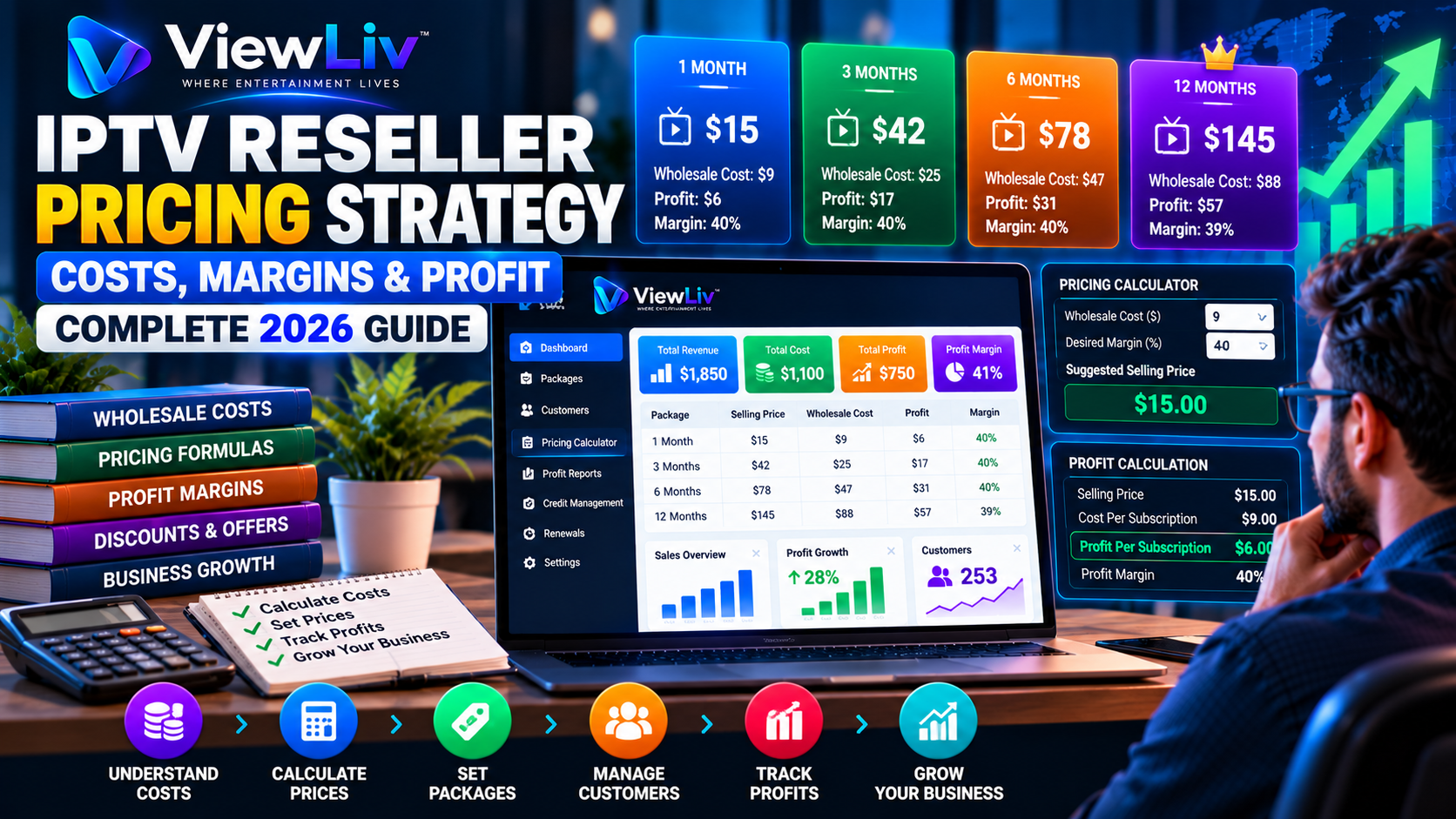
Suppose an authorized provider charges $9 for a monthly subscription.
Your direct subscription cost is $9.
Credit-Based Pricing
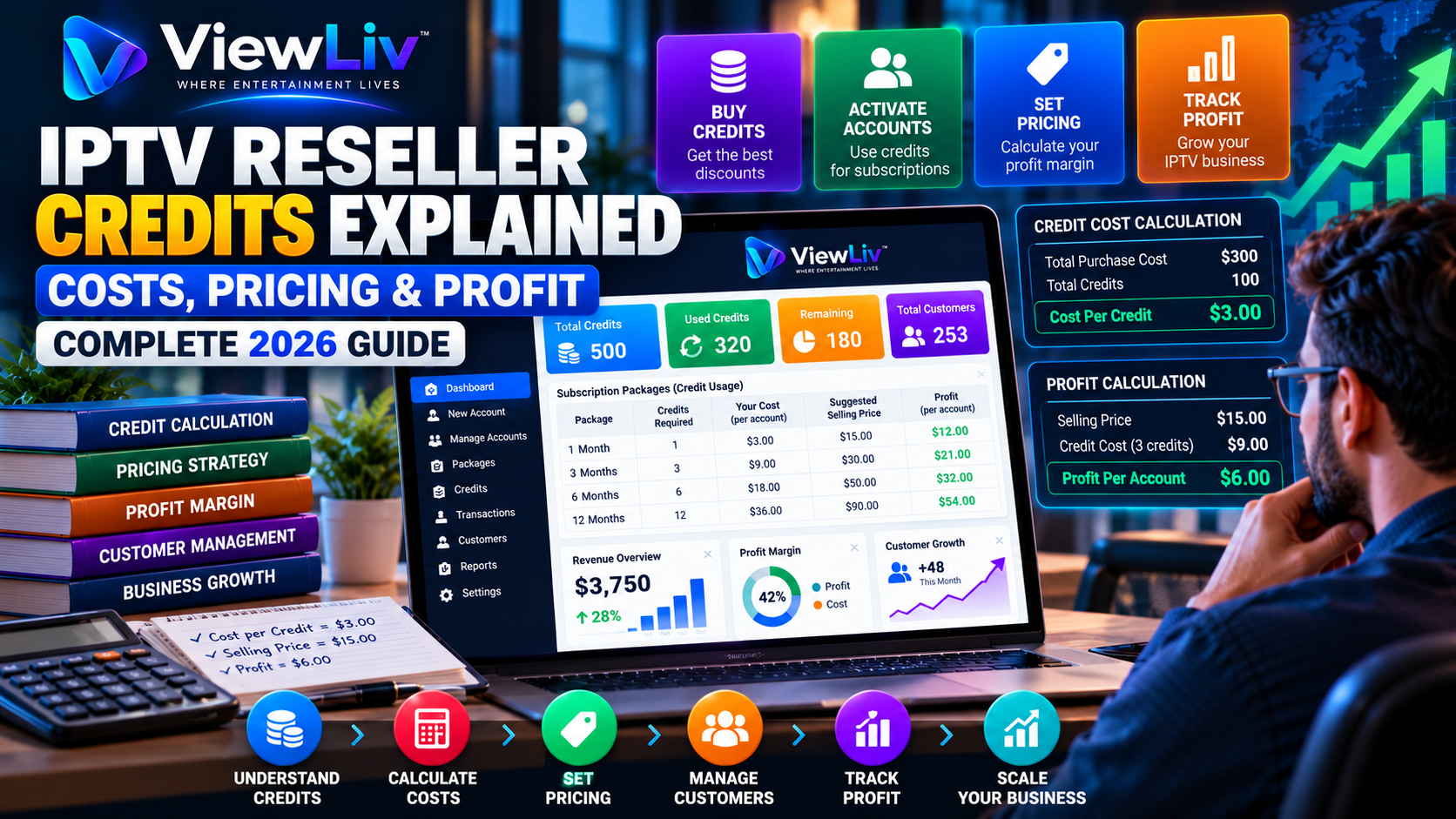
Suppose you purchase 100 credits for $300.
Cost per credit = $300 ÷ 100 = $3
If a monthly subscription requires three credits:
Subscription cost = 3 × $3 = $9
This calculation is based on an illustrative credit system. Providers use different credit requirements and pricing models.
For a detailed explanation, read our IPTV Reseller Credits Guide.
Step 2: Identify All Business Expenses
Your supplier cost is only one part of the total expense.
Other costs may include:
- Website and hosting.
- Advertising and customer acquisition.
- Payment processing.
- Customer support.
- Business management software.
- Refunds and chargebacks.
- Business registration and professional services.
- Applicable taxes.
Some expenses vary with each sale, while others remain relatively fixed.
Fixed vs Variable Costs
Fixed costs are expenses that generally do not change directly with each subscription sold, such as a fixed monthly software fee.
Variable costs increase when you sell more subscriptions, such as wholesale activation charges and per-transaction payment fees.
Understanding both types helps you calculate break-even sales volume.
Step 3: Calculate Gross Profit
Gross profit is the difference between sales revenue and the direct cost of the subscription.
Gross Profit = Selling Price − Direct Subscription Cost
Suppose:
- Selling price: $15.
- Wholesale cost: $9.
Then:
Gross Profit = $15 − $9 = $6
That $6 must still help cover other expenses.
Step 4: Understand Profit Margin vs Markup
Margin and markup are not interchangeable.
Gross Profit Margin
Gross Margin (%) = Gross Profit ÷ Selling Price × 100
For a $15 sale with a $9 direct cost:
($6 ÷ $15) × 100 = 40%
Markup
Markup (%) = Gross Profit ÷ Direct Cost × 100
Using the same numbers:
($6 ÷ $9) × 100 = 66.67%
The margin is 40%, while the markup is approximately 66.67%.
This distinction matters when setting prices.
Step 5: Calculate a Selling Price Using a Target Margin
You can estimate the price needed to achieve a target margin.
Selling Price = Cost ÷ (1 − Target Margin)
Suppose the direct subscription cost is $9 and you want a 40% gross margin.
$9 ÷ (1 − 0.40) = $15
The selling price would be $15.
This is a gross-margin calculation. It does not account for every operating expense.
Example Target Margin Table
| Direct cost | Target gross margin | Required price | |---|---:|---:| | $9 | 25% | $12.00 | | $9 | 30% | $12.86 | | $9 | 40% | $15.00 | | $9 | 50% | $18.00 |
These figures are mathematical examples, not recommended market prices.
Step 6: Create Monthly, Quarterly, and Annual Packages
Different subscription durations may appeal to different customers.
Common package periods include one, three, six, and twelve months, provided your authorized supplier supports them.
Illustrative Subscription Pricing
| Package | Wholesale cost | Retail price | Gross profit | |---|---:|---:|---:| | 1 month | $9 | $15 | $6 | | 3 months | $25 | $42 | $17 | | 6 months | $47 | $78 | $31 | | 12 months | $88 | $145 | $57 |
These hypothetical figures demonstrate how package economics can vary.
Longer packages may provide customers with a lower equivalent monthly price, but they also create longer service commitments and potential refund obligations.
Calculate the Equivalent Monthly Price
For a $145 annual package:
$145 ÷ 12 = approximately $12.08 per month
Compare that with twelve separate monthly payments of $15:
12 × $15 = $180
The difference is:
$180 − $145 = $35
The annual package costs $35 less than purchasing twelve monthly packages at the example prices.
However, the reseller should verify that the annual package still covers its wholesale and support costs.
Step 7: Avoid Excessive Discounts
Discounts can attract customers, but they reduce the amount available to cover expenses.
Suppose a subscription normally sells for $15 and costs $9.
Gross profit is $6.
If you offer a 20% discount:
Discounted price = $15 × 0.80 = $12
New gross profit:
$12 − $9 = $3
The discount reduced gross profit from $6 to $3 — a 50% decrease.
Better Discount Practices
Before offering a discount:
- Calculate the new selling price.
- Confirm the supplier cost.
- Include transaction fees.
- Estimate support expenses.
- Check the remaining margin.
- Clearly state the promotion's conditions.
Avoid promotions that cannot be sustained.
Step 8: Calculate Your Break-Even Point
The break-even point is where total revenue equals total costs.
For a simplified subscription business:
Break-Even Subscriptions = Fixed Monthly Costs ÷ Contribution per Subscription
Contribution per subscription means the selling price minus the variable costs associated with that sale.
Example
Suppose:
- Selling price: $15.
- Wholesale cost: $9.
- Other variable costs: $1.
- Monthly fixed expenses: $150.
Contribution per subscription:
$15 − $9 − $1 = $5
Break-even volume:
$150 ÷ $5 = 30 subscriptions
You would need 30 subscriptions in this simplified model to cover the $150 fixed expenses.
This assumes consistent pricing and costs and excludes any additional expenses not listed.
Step 9: Calculate Monthly Net Profit
Revenue alone does not show whether your business is profitable.
Example Monthly Financial Report
Suppose you sell 100 monthly subscriptions.
| Item | Amount | |---|---:| | Revenue: 100 × $15 | $1,500 | | Wholesale cost: 100 × $9 | $900 | | Gross profit | $600 | | Payment processing | $50 | | Marketing | $150 | | Software | $30 | | Support expenses | $70 | | Estimated profit before tax | $300 |
In this example, $300 remains after the listed expenses.
Actual net profit may differ because of taxes, refunds, additional overhead, and other factors.
Step 10: Include Payment Processing Fees
Payment fees can materially affect low-margin subscriptions.
Some processors charge a percentage of the transaction, a fixed amount, or both.
Example
Suppose the processing fee is 3% plus $0.30.
For a $15 payment:
Percentage fee = $15 × 3% = $0.45
Total fee = $0.45 + $0.30 = $0.75
If the wholesale cost is $9:
$15 − $9 − $0.75 = $5.25
This leaves $5.25 before support, marketing, taxes, and other costs.
The fee structure is hypothetical. Check the current terms and business eligibility requirements of your payment provider.
Step 11: Account for Refunds and Chargebacks
Refunds and payment disputes can reduce profitability.
Your pricing model should consider:
- Applicable consumer protection rules.
- Your published refund policy.
- Supplier refund arrangements.
- Payment dispute fees.
- Support and administration costs.
Avoid promising that all subscriptions are nonrefundable without checking applicable law and your contractual obligations.
Clear customer information and accurate advertising can help reduce disputes.
Step 12: Compare Pricing Across Authorized Suppliers
If you work with multiple providers, compare more than the wholesale price.
Consider:
- Content distribution authorization.
- Supported markets.
- Wholesale package costs.
- Service reliability.
- Customer support.
- Refund arrangements.
- Credit expiration.
- Device compatibility.
- Contract termination conditions.
Example Supplier Comparison
| Factor | Supplier A | Supplier B | |---|---|---| | Monthly wholesale cost | $9 | $11 | | Refund terms | Contract-dependent | Contract-dependent | | Support arrangements | To be verified | To be verified | | Credit expiry | To be verified | To be verified | | Authorized markets | To be verified | To be verified |
These are hypothetical suppliers. The lower wholesale price does not necessarily indicate the better business arrangement.
Step 13: Track Customer Payments and Outstanding Balances
A completed subscription sale does not always mean the full payment has been received.
Suppose:
- Selling price: $20.
- Wholesale cost: $12.
- Customer payment received: $15.
The records should show:
- Sales revenue: $20.
- Direct cost: $12.
- Gross profit: $8.
- Payment received: $15.
- Outstanding customer balance: $5.
The $8 gross profit does not mean the customer has paid in full.
Separate sales records from cash collections to avoid financial confusion.
Step 14: Track Subscription Renewals
Renewals are important for subscription businesses.
Maintaining accurate expiry dates helps prevent missed customer communications and incorrect account extensions.
Recommended Renewal Workflow
- Record the original activation date.
- Record the correct expiry date.
- Review subscriptions approaching expiry.
- Send appropriate renewal reminders.
- Confirm the customer's package.
- Verify the renewal cost.
- Record payment.
- Renew through the authorized provider.
- Update the new expiry date.
Do not assume that every provider preserves unused subscription days during early renewal.
Step 15: Use Business Management Software
As customer numbers grow, manual calculations can become difficult.
A business management system can help track:
- Sales.
- Supplier purchases.
- Customer payments.
- Customer receivables.
- Supplier payables.
- Subscription inventory.
- Expiry dates.
- Gross profit.
- Financial reports.
ViewLiv Inventory Software
ViewLiv Inventory Software is designed to help businesses organize inventory, customers, vendors, sales, purchases, payments, and subscription-related records.
Its customer and vendor ledgers, expiry tracking, and reporting tools can help resellers manage business information alongside an authorized provider's reseller panel.
ViewLiv Inventory Software does not grant content distribution rights or independently provide IPTV subscriptions.
Visit ViewLiv for product information.
Step 16: Review Your Prices Regularly
Your costs may change over time.
Supplier prices, payment processing fees, advertising expenses, and customer support requirements can all affect margins.
Review pricing when:
- A supplier changes wholesale rates.
- Credit conversion rules change.
- Payment fees increase.
- Customer support expenses rise.
- A package is added or discontinued.
- Refund rates change.
- Your target market changes.
Communicate price changes clearly and honor applicable contractual obligations.
Common IPTV Reseller Pricing Mistakes
1. Pricing Based Only on Competitors
Competitor prices may not reflect your supplier costs or business expenses.
2. Ignoring Payment Fees
Transaction fees reduce the amount retained from each sale.
3. Confusing Markup With Margin
These calculations use different denominators.
4. Offering Unsustainable Discounts
A discount may sharply reduce profit even when the percentage appears small.
5. Forgetting Support Expenses
Customer assistance requires time and resources.
6. Buying Too Many Prepaid Credits
Unused or expiring credits can create financial losses.
7. Ignoring Refund Risk
Refunds and disputes can affect cash flow and profitability.
8. Mixing Sales With Payments Received
Outstanding customer balances should be tracked separately.
9. Not Comparing Package Profitability
A longer subscription is not automatically more profitable.
10. Failing to Review Prices
Costs and market conditions change.
Frequently Asked Questions
How do I calculate IPTV reseller subscription prices?
Start with your wholesale cost, add relevant operating expenses, and calculate a selling price that provides an appropriate margin.
What is a good IPTV reseller profit margin?
There is no universal ideal margin. The appropriate margin depends on costs, competition, service obligations, and business risks.
How do I calculate profit per subscription?
Subtract the direct subscription cost from the selling price to calculate gross profit. Deduct additional expenses to assess net profitability.
Should annual subscriptions be cheaper than monthly subscriptions?
They may have a lower equivalent monthly price, but the discount must be supported by actual costs and contractual terms.
How do I calculate a reseller credit cost?
Divide the total credit purchase cost by the number of credits purchased, then multiply by the credits required for the selected package.
What is the difference between markup and margin?
Markup measures profit relative to cost, while margin measures profit relative to selling price.
Can discounts reduce profit significantly?
Yes. A discount reduces selling price while many costs remain unchanged.
How do I calculate the break-even point?
Divide fixed costs by contribution per subscription, assuming a consistent contribution amount.
Do payment processing fees affect IPTV reseller profit?
Yes. Fees reduce the amount retained from each transaction.
Can inventory software help with subscription pricing?
Yes. Suitable software can help track supplier costs, sales, payments, and profitability.
How often should I review subscription prices?
Review them whenever important costs or business conditions change, and periodically as part of financial planning.
Can I charge different prices for different countries?
Potentially, subject to contractual terms, authorized territories, applicable laws, and customer transparency requirements.
Is the cheapest IPTV subscription always the best option?
No. Licensing, service quality, support, reliability, and contractual conditions also matter.
Final Thoughts
A sustainable IPTV reseller pricing strategy begins with accurate cost calculations.
Before setting a retail price, understand the supplier's wholesale charges, credit conversion rules, transaction fees, support expenses, and other operating costs.
Then calculate your gross profit, target margin, and break-even point.
Avoid relying on revenue alone as a measure of success. Track customer payments, supplier costs, refunds, and renewals so you can evaluate profitability accurately.
For more information, explore these related ViewLiv guides:
- How to Start an IPTV Reseller Business in 2026
- IPTV Reseller Panel Explained
- IPTV Reseller Credits Explained
Visit the ViewLiv Blog for more tutorials about IPTV reseller education, inventory management, and subscription management.
ViewLiv — Where Entertainment Lives.
Disclaimer: This article is for educational purposes and does not constitute legal, tax, accounting, or financial advice. All numerical examples are hypothetical. IPTV services must be distributed with the necessary content rights and resale authorization.