Understanding IPTV reseller credits is essential for anyone operating an authorized IPTV subscription resale business.
Credits are commonly used by IPTV providers to manage prepaid account activations and subscription renewals. However, the actual value of a credit, the number required for each package, and the reseller's profit depend on the provider's pricing system.
If you misunderstand credit costs, you could sell subscriptions at the wrong price, lose money on renewals, or tie up too much capital in unused credits.
In this 2026 guide, we'll explain how IPTV reseller credits work, how to calculate their real cost, how to set subscription prices, and how to track reseller profitability.
What Are IPTV Reseller Credits?
IPTV reseller credits are prepaid units that some service providers use to charge resellers for subscription activations.
Instead of paying a separate invoice each time a customer purchases a subscription, the reseller purchases credits in advance.
The provider deducts credits when the reseller activates or renews an account.
For example, a provider might require:
- 1 credit for a particular monthly subscription.
- 3 credits for a particular three-month subscription.
- 6 credits for a particular six-month subscription.
- 12 credits for a particular annual subscription.
These are illustrative values only. Actual credit requirements vary by provider, package, and commercial agreement.
Important: Credits are a billing mechanism, not proof that a provider has legal rights to distribute television channels, films, or sports programming. Only resell services for which the necessary content rights and resale authorization have been verified.
How Does the IPTV Reseller Credit System Work?
A typical credit-based workflow has six stages.
Step 1: Register With an Authorized Provider
The reseller establishes a commercial relationship with a provider and receives access to its reseller account-management system.
Step 2: Purchase Credits
The reseller buys an agreed quantity of credits at the provider's wholesale rate.
Step 3: Receive a Credit Balance
The purchased credits appear in the reseller's account, subject to the provider's terms.
Step 4: Activate a Subscription
When a customer purchases a package, the reseller creates the authorized account and the provider deducts the required credits.
Step 5: Record the Sale
The reseller records the selling price, credit cost, payment received, and subscription expiry date.
Step 6: Calculate Profit
The reseller compares revenue against direct subscription costs and other business expenses.
A reseller panel may track the credit deduction, but separate business records may still be needed to calculate actual profit.
How Much Does One IPTV Reseller Credit Cost?
There is no universal price for an IPTV reseller credit.
Credit values depend on the provider's wholesale pricing and any negotiated discounts.
Formula: Cost Per Credit
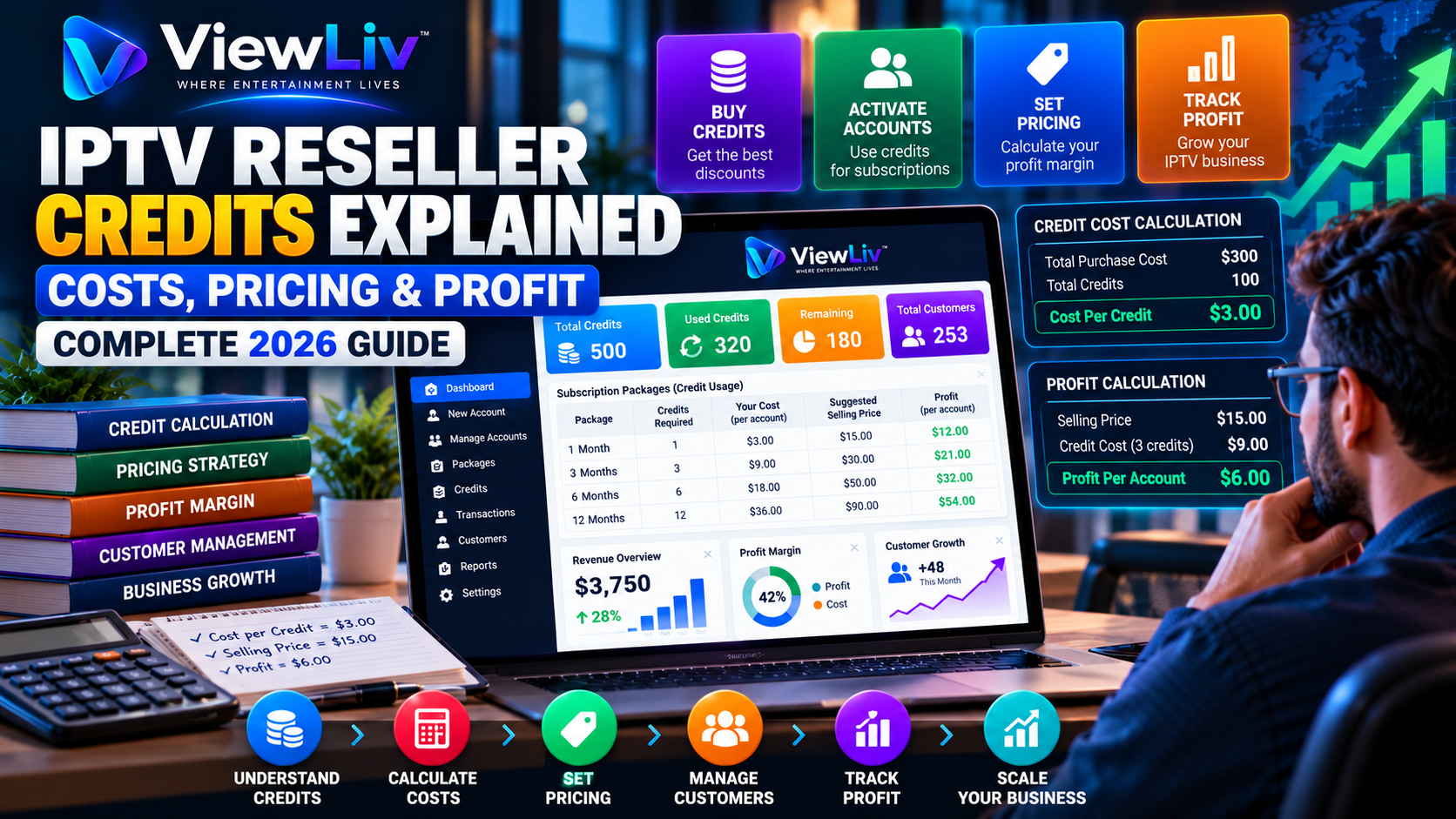
Cost Per Credit = Total Credit Purchase Cost ÷ Number of Credits Purchased
Suppose you purchase 100 credits for $300.
Your cost per credit is:
$300 ÷ 100 = $3
Now suppose you purchase 200 credits for $500.
Your cost per credit is:
$500 ÷ 200 = $2.50
In this hypothetical example, the larger purchase reduces the average cost per credit.
However, buying more credits is not automatically better. You must also consider expiration dates, refund conditions, cash flow, and the risk of unused inventory.
How to Calculate Subscription Cost From Credits
The number of credits required for a package determines its direct credit cost.
Formula
Subscription Credit Cost = Credits Required × Cost Per Credit
Suppose your average cost per credit is $2.50.
| Subscription package | Credits required | Direct credit cost | |---|---:|---:| | 1 month | 1 | $2.50 | | 3 months | 3 | $7.50 | | 6 months | 6 | $15.00 | | 12 months | 12 | $30.00 |
These values are hypothetical and do not represent an actual provider's pricing.
Why Package-Specific Costs Matter
A provider may charge different credit amounts for different packages, even when the subscription durations appear similar.
For example, a promotional annual package might consume fewer credits than twelve separate monthly activations.
Always calculate the actual package cost rather than assuming it is proportional to the number of months.
How to Calculate IPTV Reseller Gross Profit
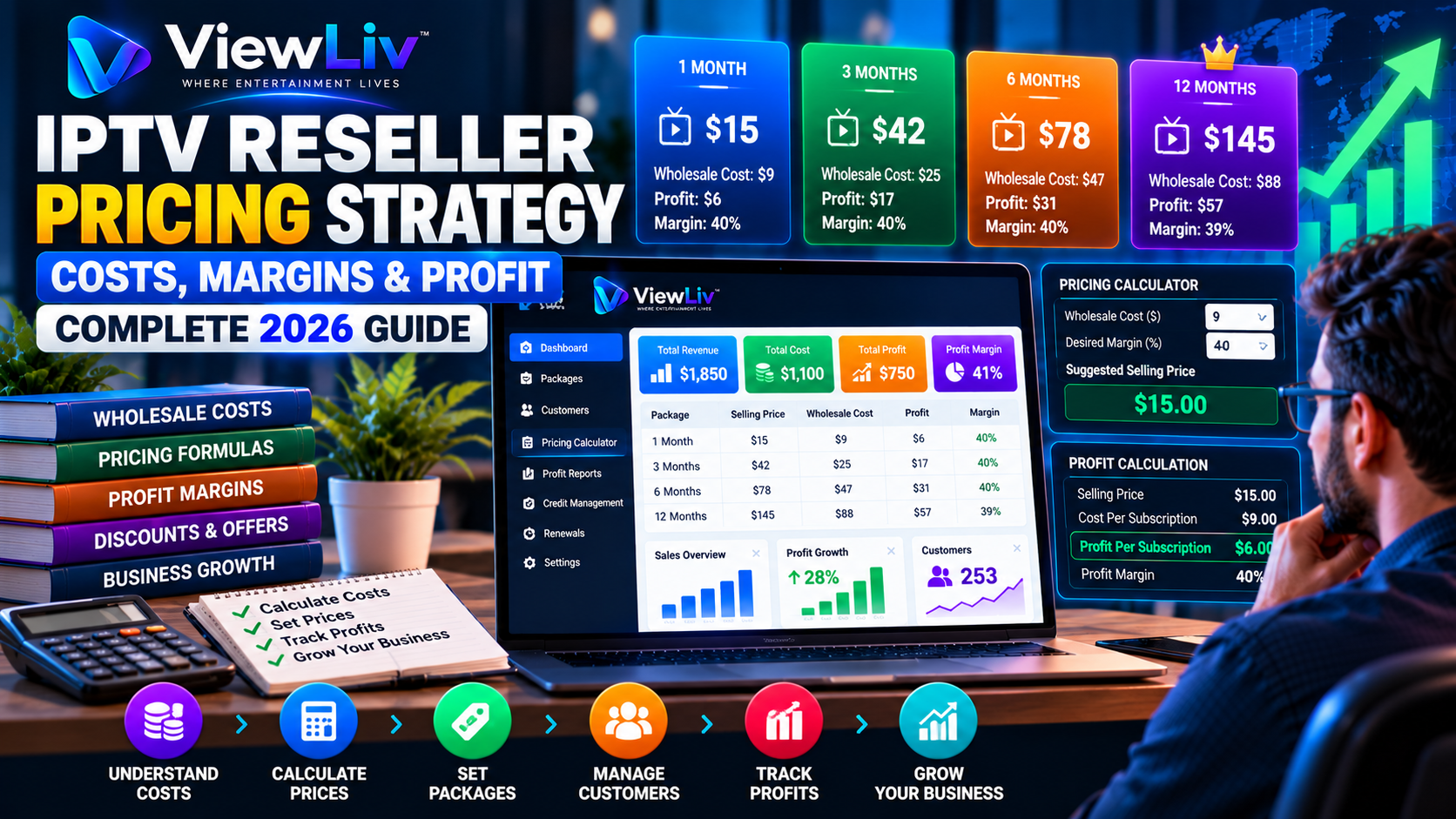
Gross profit is the difference between the selling price and the direct cost of providing the subscription.
Gross Profit Formula
Gross Profit = Selling Price − Direct Subscription Cost
Suppose:
- Subscription selling price: $15.
- Direct credit cost: $9.
Your gross profit is:
$15 − $9 = $6
This does not mean your business earned $6 in final net profit.
You may still need to pay for advertising, software, support, transaction fees, and other expenses.
How to Calculate IPTV Reseller Profit Margin
Profit margin shows how much of your selling price remains after the relevant costs.
Gross Margin Formula
Gross Margin (%) = Gross Profit ÷ Selling Price × 100
Using the previous example:
- Selling price: $15.
- Direct cost: $9.
- Gross profit: $6.
Gross margin:
($6 ÷ $15) × 100 = 40%
This means 40% of the selling price remains as gross profit before other expenses.
Profit Margin vs Markup
Margin and markup are different.
Margin = Profit ÷ Selling Price × 100
Markup = Profit ÷ Cost × 100
For the same $15 sale and $9 cost:
- Gross margin: 40%.
- Markup: approximately 66.7%.
Confusing these percentages can lead to incorrect pricing decisions.
How to Set IPTV Subscription Selling Prices
A sustainable selling price should cover direct subscription costs, operating expenses, and the business's desired profit.
Consider These Costs
- Provider credit cost.
- Payment processing fees.
- Marketing expenses.
- Customer support.
- Business management software.
- Refund and chargeback risk.
- Taxes.
- Website and hosting expenses.
Example Retail Pricing Calculation
Suppose your estimated cost structure for one subscription is:
| Expense | Amount | |---|---:| | Credit cost | $9.00 | | Payment fee | $0.75 | | Allocated support cost | $1.25 | | Allocated marketing cost | $1.00 | | Total estimated cost | $12.00 |
If you sell the subscription for $18:
$18 − $12 = $6 estimated contribution
This is before any additional costs not included in the calculation.
Pricing for a Target Margin
If you want a particular margin on the costs included in your calculation, use:
Selling Price = Total Included Cost ÷ (1 − Target Margin)
For example, with $12 in included costs and a 25% target margin:
$12 ÷ 0.75 = $16
This calculation assumes the included costs are correctly estimated and do not vary with the selling price.
It is a planning formula, not a guarantee of profitability.
IPTV Reseller Credit Pricing Example
Consider a hypothetical reseller who purchases 100 credits for $300.
The cost per credit is $3.
Suppose the provider charges three credits for each monthly activation.
The direct subscription cost is:
3 × $3 = $9
The reseller sells each subscription for $15.
Example for 20 Customers
| Metric | Calculation | Amount | |---|---|---:| | Revenue | 20 × $15 | $300 | | Credits used | 20 × 3 | 60 credits | | Direct credit cost | 60 × $3 | $180 | | Gross profit | $300 − $180 | $120 | | Gross margin | $120 ÷ $300 | 40% |
The reseller would have 40 credits remaining, assuming no other deductions or adjustments.
The remaining credits are not the same as cash in the bank. Their recoverable value depends on the provider's terms.
What Happens to Unused IPTV Reseller Credits?
Unused credits may remain available, expire after a specified period, or be subject to other restrictions.
The rules depend on the provider.
Before buying credits, ask:
- Do credits expire?
- Can unused credits be refunded?
- Can credits be transferred?
- Are credits valid for all packages?
- Can package prices change?
- What happens if the provider stops operating?
- Can credits be reversed after a failed activation?
- Are credits deducted immediately or after activation succeeds?
Understanding these conditions can help you manage financial risk.
Is Buying IPTV Credits in Bulk More Profitable?
Bulk purchases sometimes reduce the average wholesale cost.
But a discount is only useful if you can use the credits under the provider's terms.
Example
Suppose:
- Package A: 100 credits for $300.
- Package B: 200 credits for $500.
The cost per credit is:
- Package A: $3.
- Package B: $2.50.
Package B offers a lower average cost.
However, it also requires $200 more upfront.
If customer demand is uncertain or the credits expire, the larger purchase may create unnecessary risk.
Better Buying Strategy
Estimate your expected subscription activations, renewal demand, available cash, and supplier reliability before purchasing.
Avoid buying large nonrefundable balances solely because the advertised cost per credit is lower.
How to Track IPTV Reseller Credit Balances
Credit tracking is essential for reconciling purchases, activations, and remaining balances.
Credit Balance Formula
Closing Credits = Opening Credits + Credits Purchased + Credits Returned − Credits Used − Other Adjustments
Suppose:
- Opening credits: 40.
- New credits purchased: 100.
- Credits used: 65.
- Credits returned: 5.
- Other adjustments: 0.
Closing balance:
40 + 100 + 5 − 65 = 80 credits
Example Credit Ledger
| Transaction | Credits added | Credits deducted | Balance | |---|---:|---:|---:| | Opening balance | — | — | 40 | | Credit purchase | 100 | — | 140 | | Subscription activation | — | 30 | 110 | | Subscription renewals | — | 35 | 75 | | Credit reversal | 5 | — | 80 |
A credit ledger makes it easier to identify missing deductions, incorrect activations, or reconciliation errors.
How to Track Credit Costs When Purchase Prices Change
One challenge arises when a reseller purchases credits at different prices.
For example:
- First purchase: 100 credits at $3 each.
- Second purchase: 100 credits at $2.50 each.
The reseller now has 200 credits purchased for a total of $550.
Weighted Average Cost
Weighted Average Cost = Total Cost of Available Credits ÷ Total Available Credits
In this simplified example:
$550 ÷ 200 = $2.75 per credit
A weighted-average approach can help estimate the cost of credits used.
However, inventory valuation and accounting treatment depend on the applicable accounting framework and the nature of the credits.
For financial statements and tax reporting, consult an appropriately qualified professional.
How to Manage Credits From Multiple IPTV Suppliers
Resellers working with more than one authorized provider should maintain separate credit records.
Suppose:
- Supplier A: 50 credits at $3 each.
- Supplier B: 80 credits at $5 each.
These credits should not automatically be treated as interchangeable.
They may have different:
- Subscription packages.
- Activation costs.
- Expiry rules.
- Refund conditions.
- Transfer restrictions.
- Service agreements.
Recommended Supplier Credit Records
Maintain:
- Supplier name.
- Purchase date.
- Credits purchased.
- Purchase cost.
- Credits used.
- Remaining balance.
- Cost per credit.
- Relevant expiry date.
- Related customer activations.
This makes supplier comparisons and financial reconciliation more reliable.
IPTV Reseller Credits vs Customer Payments
Credit purchases and customer payments are separate business transactions.
A reseller may purchase credits before receiving any customer payments.
Similarly, a customer may purchase a subscription on credit and pay later.
Example
A reseller activates a subscription with a direct cost of $9.
The customer price is $15.
The customer pays $10 immediately.
The business records should reflect:
- Sale: $15.
- Direct subscription cost: $9.
- Customer payment received: $10.
- Outstanding customer balance: $5.
- Gross profit on the sale: $6.
The gross profit calculation does not mean all revenue has been collected.
This is why customer receivables should be tracked separately from provider credits.
Why a Reseller Panel May Not Be Enough for Accounting
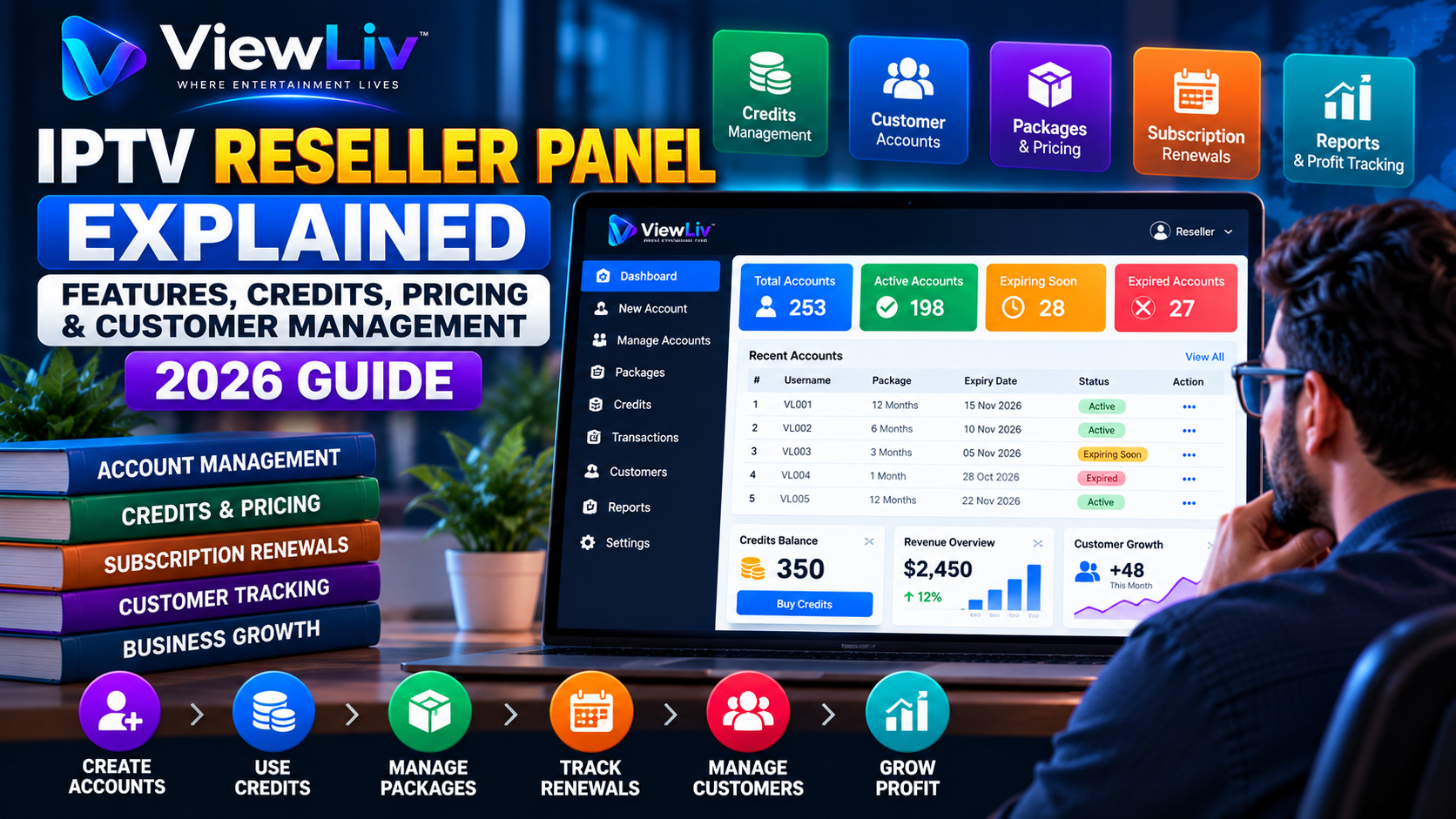
An IPTV reseller panel may show how many credits were purchased and used.
However, it may not record:
- Actual customer selling prices.
- Partial customer payments.
- Customer outstanding balances.
- Supplier invoices.
- Marketing expenses.
- Software expenses.
- Business overhead.
- Complete financial reports.
Without these records, the reseller may struggle to calculate true profitability.
Using ViewLiv Inventory Software for Credit and Subscription Management
ViewLiv Inventory Software is designed to help businesses maintain customer, vendor, inventory, transaction, and subscription records.
For a reseller business, useful capabilities include:
- Supplier and vendor registration.
- Customer records with unique codes.
- Purchase and sales entries.
- Inventory quantity tracking.
- Supplier cost recording.
- Customer receivables.
- Vendor payables.
- Subscription expiry tracking.
- Customer and vendor ledgers.
- Financial reports.
- Data export and backup.
These features can help a reseller organize credit-related business records, subject to how products and transactions are configured.
For example, a reseller may record purchased credits or subscription units as inventory, then record the corresponding sales and costs when those units are used.
The reseller should ensure the chosen recording method accurately reflects the provider's billing model.
ViewLiv Inventory Software does not itself create streaming subscriptions or grant content distribution rights.
Learn more at ViewLiv.
Common IPTV Reseller Credit Mistakes
1. Assuming All Credits Have the Same Value
Different providers may use entirely different credit systems.
2. Ignoring Credit Expiry
Unused credits can become a financial loss if they expire without compensation.
3. Buying Too Many Credits
Bulk purchases may create cash-flow problems.
4. Selling Below Total Cost
A subscription may appear profitable when only its credit cost is considered, but lose money after other expenses.
5. Confusing Margin and Markup
Incorrect calculations can produce unsuitable selling prices.
6. Not Tracking Customer Payments
An activated subscription is not necessarily a fully paid sale.
7. Mixing Multiple Supplier Balances
Separate credit balances are necessary for accurate supplier reconciliation.
8. Failing to Record Refunds and Reversals
Credit returns and adjustments should be documented.
9. Ignoring Supplier Terms
Always review expiration, refund, pricing, and service conditions.
10. Treating Credits as Guaranteed Cash Value
Prepaid credits may not be redeemable for money.
Frequently Asked Questions
What are IPTV reseller credits?
They are prepaid units used by some providers to charge resellers for subscription activations and renewals.
How much does one IPTV credit cost?
There is no standard price. Divide the total purchase cost by the number of credits purchased to calculate the average cost.
How many credits are needed for a one-month subscription?
It depends on the provider and selected package. There is no universal conversion.
How do I calculate IPTV reseller profit?
Subtract direct subscription costs from revenue to calculate gross profit, then account for operating expenses to determine net profit.
What is a good IPTV reseller profit margin?
There is no universal ideal margin. It depends on the supplier's prices, support costs, marketing expenses, taxes, and business risks.
Are IPTV reseller credits refundable?
Some providers may offer refunds or reversals, while others do not. Check the agreement.
Do IPTV reseller credits expire?
They may. Expiry rules vary between providers.
Is buying more reseller credits cheaper?
Sometimes bulk purchases reduce the average cost, but they may also increase financial risk.
Can I transfer credits between reseller panels?
Only if the relevant provider supports and authorizes transfers.
Can I manage credits from multiple suppliers?
Yes, but keep separate records because pricing and credit rules can differ.
Can reseller panels calculate net profit automatically?
Some provide financial features, but many do not capture all business costs and customer payments.
Can inventory software track IPTV reseller credits?
Suitable inventory software can help record credit purchases, quantities, costs, and related transactions, depending on configuration.
What is the difference between gross profit and net profit?
Gross profit subtracts direct costs from revenue. Net profit also accounts for other relevant business expenses.
Can I sell subscriptions before buying credits?
That depends on the provider's billing arrangement and whether the account can be activated under the agreed terms.
What happens if I run out of credits?
A credit-based panel may prevent new activations or renewals until sufficient credits are available.
Final Thoughts
IPTV reseller credits can simplify prepaid subscription management, but they require careful financial tracking.
To run a sustainable authorized reseller business, you should understand:
- How much each credit costs.
- How many credits each package requires.
- Your actual subscription cost.
- Your gross margin and net profit.
- Your remaining credit balance.
- Your customer receivables.
- Your supplier obligations.
Accurate records help you make better pricing decisions, avoid unnecessary purchases, and identify financial problems before they grow.
For more information, read IPTV Reseller Panel Explained: Features, Credits, Pricing & Customer Management.
You can also explore How to Start an IPTV Reseller Business in 2026.
Visit the ViewLiv Blog for more educational guides about IPTV reseller operations, subscription management, and business software.
ViewLiv — Where Entertainment Lives.
Disclaimer: This article is educational and does not constitute legal, financial, accounting, or tax advice. All numerical examples are hypothetical. IPTV services must be distributed with the appropriate content rights and commercial authorization.